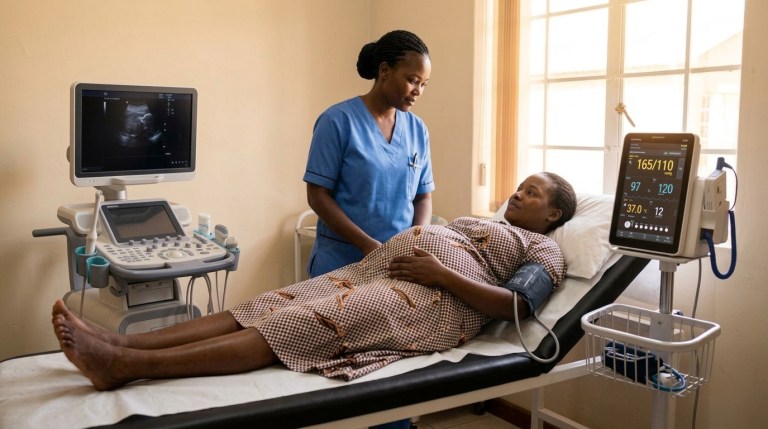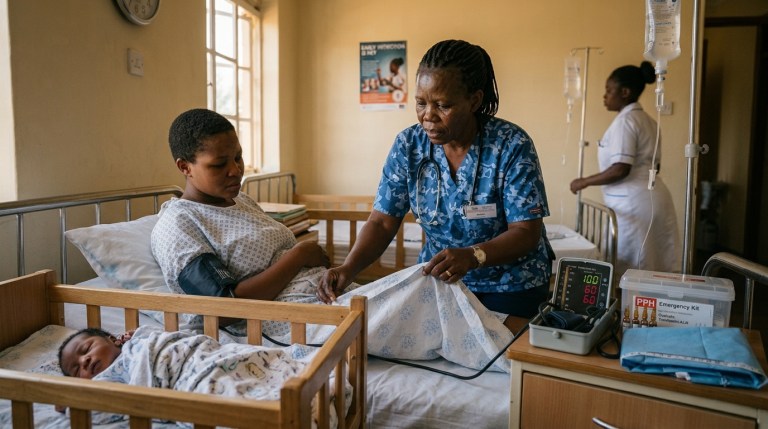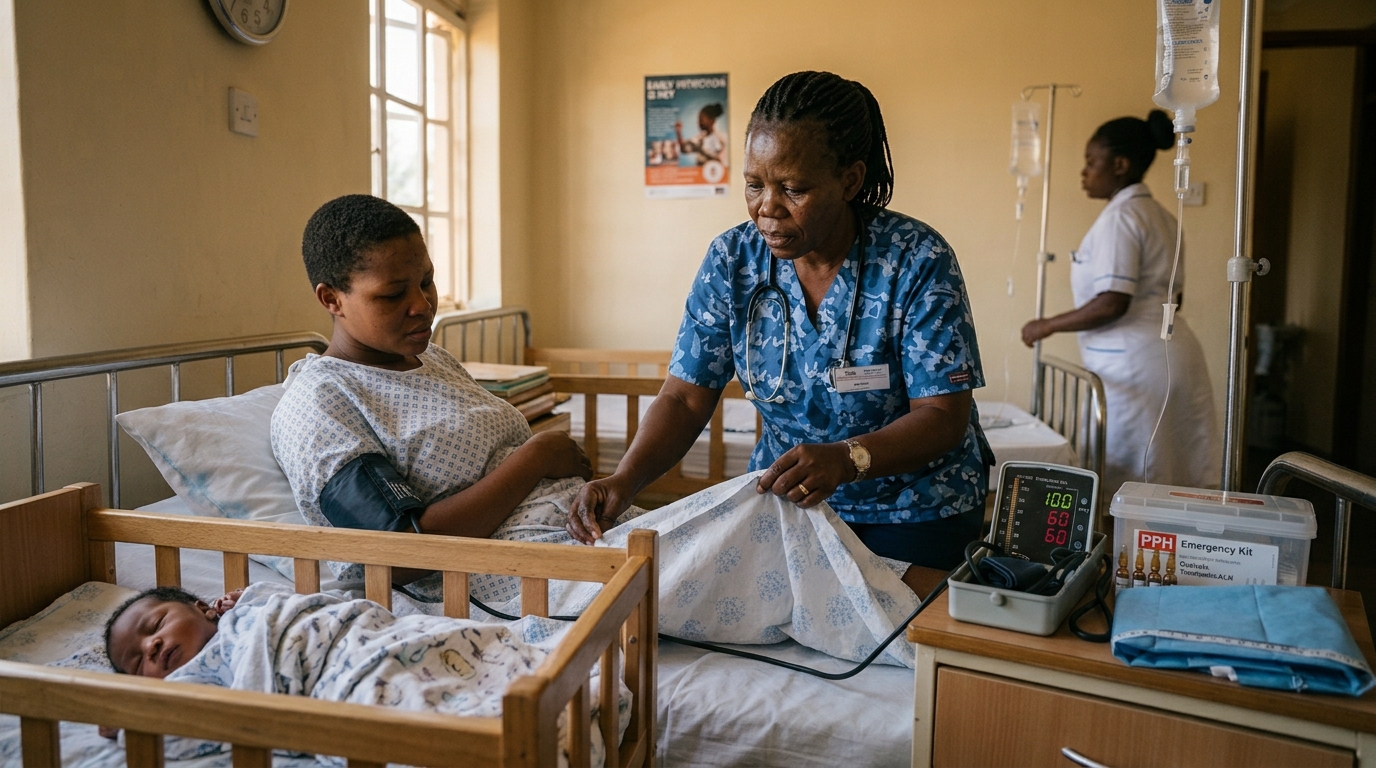
Early detection of postpartum hemorrhage in Africa. Credit: Nanobanana
Postpartum hemorrhage in Africa remains a leading cause of maternal death, even though the condition is largely preventable. It is an emergency and, without timely treatment, can be fatal.
Postpartum hemorrhage (PPH) refers to excessive bleeding after childbirth. The World Health Organization (WHO) defines it as blood loss of 500 mL after a vaginal birth and 1000 mL after a cesarean delivery.
It is classified by timing. Primary PPH happens within 24 hours of delivery. Secondary PPH happens after 24 hours and up to 12 weeks after birth. Without timely treatment, a woman can die within a few hours.
WHO reported in 2023 that about 14 million women worldwide experience PPH each year, particularly in low-income countries. In Sub-Saharan Africa, it is estimated that PPH is responsible for 30-50% of maternal deaths.
Why is postpartum hemorrhage in Africa still a leading cause of death?
Late detection of bleeding
The most common cause of PPH is the inability of the uterus to contract after delivery. Without timely and appropriate action, a woman can die within a few hours.
A 2023 qualitative study examined the factors that influenced PPH detection and management amongst health providers in nine hospitals in Kenya, Nigeria and South Africa. Health providers often detect bleeding visually, for example by judging the amount of blood on the linen. The authors note that this approach is unreliable and usually inaccurate. The lack of an objective measure of blood loss is a cause of delayed detection.
Early warning signs can also be missed. An autopsy study in Maputo, Mozambique found that women who died from PPH were about half as likely as women who died of other causes to have had blood tests on admission. The authors suggest that early signs of hemorrhage may have gone unnoticed.
Anemia and other risk factors
Many women arrive at the hospital already short of blood. In a pilot study in Mozambique, anemia was a strong predictor of PPH and affected 54% of the women with lab results. In the Maputo autopsy study, 65.8% of women with admission blood tests showed mostly moderate or severe Anemia.
Malaria in Pregnancy is also another cause of anemia. A WHO newsletter notes that anemia can raise the risk of death from PPH.
Other factors raise the odds of PPH. A systematic review and meta-analysis of studies across Africa found that women who delivered by Caesarean section had nearly four times the odds of PPH. Women who delivered large babies had about three times the odds. Multiple pregnancies and hypertensive disorders of pregnancy are also listed as risk factors.
Some women who have PPH have none of these risk factors, so care teams must be ready for every birth and watch every woman closely after delivery.
Shortages in the Health system
Clinical delays are only part of the story. Deaths as a result of PPH are also influenced by what happens before a woman gets to the delivery room and the available resources the facility has.
- Drugs, equipment and Staff – A scoping review of essential medicines in African countries points to persistent problems with availability and affordability. A uterine-contracting drug that is out of stock cannot save anyone. All necessary drugs and equipment should be kept together in one emergency kit for accessibility. A study reviewing the factors influencing PPH in Nigeria, Kenya, and South Africa found that staff shortages are barriers to administering care, because a protocol needs someone available to carry it out.
- Getting to care- Delays in deciding to seek care, in reaching a facility, and in receiving care once there all determine the outcome of PPH. A woman who bleeds heavily at home or on the road may never reach the stage at which the clinical tools described here can help.
- Blood for transfusion- Severe hemorrhage can require transfusion, so a facility without a reliable blood supply can’t save a bleeding woman even if its drugs and staff are in place.
Together, these factors explain why postpartum hemorrhage is still a leading cause of maternal death in Africa.
Can Africa Reduce Maternal Deaths From Postpartum Hemorrhage?
WHO has published a roadmap to combat postpartum hemorrhage between 2023 and 2030, and many of the tools it relies on already exist.
Active Management of the third stage of Labor (delivery of the placenta)
This is a set of steps taken right after the baby is born, built around a drug that helps the uterus contract. It substantially reduces blood loss. Some women still bleed heavily with this approach, and newer options like tranexamic acid, heat-stable Carbetocin, which is also a uterotonic drug, and low-cost tamponade devices help to prevent and treat PPH.
The E-MOTIVE Treatment bundle
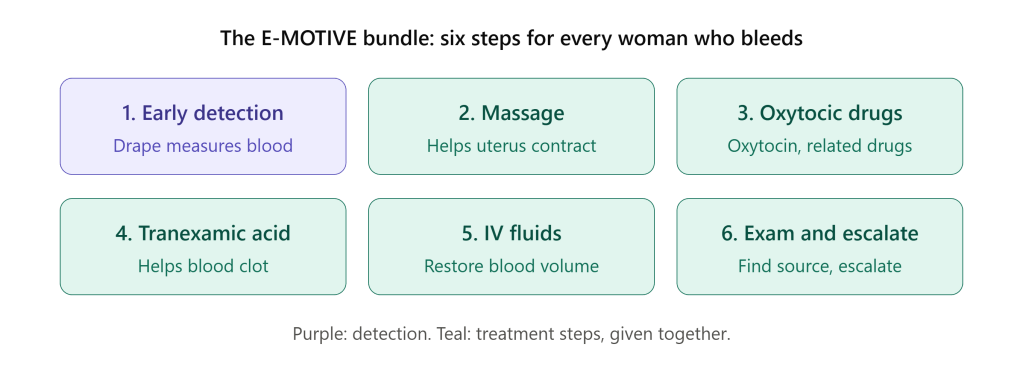
E-MOTIVE is a care bundle recommended by the WHO, a set of steps given for the management of every woman who bleeds. It consists of;
- Early detection of blood loss – using a calibrated drape, a sheet placed under the woman that collects and measures her blood.
- Massage- Massaging the uterus to help it contract and reduce bleeding
- Oxytocic drugs- Administration of oxytocin and other related drugs that help the uterus to contract
- Tranexamic acid – A medication given to help blood clot and reduce severe bleeding
- Intravenous(IV) fluids- for resuscitation and to prevent further deterioration
- Examination and Escalation- Inspecting the genital tract and placenta for tears or retained tissue, and escalating care to advanced medical teams or surgical procedures if bleeding continues
WHO’s 2023 guidelines recommend measuring blood loss with a calibrated drape and linking it to a standard treatment bundle. In the large trial behind that recommendation, teams started the bundle when measured blood loss reached 500 mL, or 300 mL if the woman also showed early warning signs.
The trial, run in hospitals in Nigeria, Kenya, Tanzania and South Africa, found that the bundle reduced a combined outcome of severe PPH, surgery to stop the bleeding, or death from bleeding by 60% compared with usual care. That figure is for the combined outcome, not for deaths alone, and the trial covered vaginal births.
In a related analysis, the median time to diagnose bleeding was 15 to 17 minutes in Nigeria, Kenya, and Tanzania, and 30 minutes in South Africa. Every case that needed treatment was diagnosed within 90 minutes of birth. These results suggest that early recognition can be improved with training and specific protocols.
Conclusion
Postpartum hemorrhage is still a leading cause of maternal mortality in Africa because bleeding is detected late and health systems are short of drugs, staff, and the means to respond. Measuring blood loss objectively, treating with a standard care bundle like the E-MOTIVE, and keeping supplies readily available can help improve outcomes.
Where do you see the biggest barrier to ending these deaths: late detection, missing drugs and staff, or the distance to care? Share your thoughts in the comments.
Sources
- WHO, A roadmap to combat postpartum hemorrhage between 2023 and 2030. Available here
- Ibrahim AM et al., Postpartum hemorrhage and associated risk factors in Africa: a systematic review and meta-analysis. International Journal of Africa Nursing Sciences, 2026. Available here
- Factors influencing postpartum hemorrhage detection and management and the implementation of the E-MOTIVE bundle in Kenya, Nigeria, and South Africa. Implementation Science. Available here
- Maputo autopsy study, Blood Global Hematology (ASH). Available here
- Lancaster L et al., Maternal death and postpartum hemorrhage in sub-Saharan Africa: a pilot study in metropolitan Mozambique. Research and Practice in Thrombosis and Haemostasis, 2020. Available here
- Yenet A et al., Challenges to the availability and affordability of essential medicines in African countries: a scoping review. ClinicoEconomics and Outcomes Research, 2023. Available here
- WHO, Postpartum hemorrhage: reducing the global burden, Making Pregnancy Safer newsletter, Issue 4, 2007 (for malaria and anemia, and for “can die within a few hours”). Available here.
- WHO, Recommendations on the assessment of postpartum blood loss and use of a treatment bundle for postpartum hemorrhage, 2023. Available here
- Secondary postpartum hemorrhage, Fetal and Maternal Medicine Review (for the 12-week limit). Available here
- University of Oxford summary of the E-MOTIVE diagnosis-time study. Available here
- Gallos I et al., Randomized trial of early detection and treatment of postpartum hemorrhage, NEJM, 2023. Available here
- Emenalom EC, et al. Maternal death and postpartum hemorrhage in sub-Saharan Africa: insights from autopsies in Mozambique. Blood Global Hematology. 2025;1(1):100008. Available here
About the Author