Addis Ababa/Brazzaville, 5 June 2026 — The Africa Centres for Disease Control and Prevention (Africa CDC) and the World Health Organisation (WHO) have unveiled a joint Ebola continental preparedness and response plan. The plan is aimed at strengthening Africa’s fight against the ongoing Ebola outbreak caused by the Bundibugyo virus species, one of the less common but highly dangerous forms of the Ebola virus.
The six-month plan, running from June to November 2026, seeks to mobilize approximately US$518 million to support outbreak preparedness, detection, and response efforts across affected and at-risk countries. The initiative brings governments, communities, technical partners, and donors under a unified “One Response” framework designed to coordinate action and prevent wider regional spread.

The figure shows a summary of how the money will be allocated across preparedness and response.
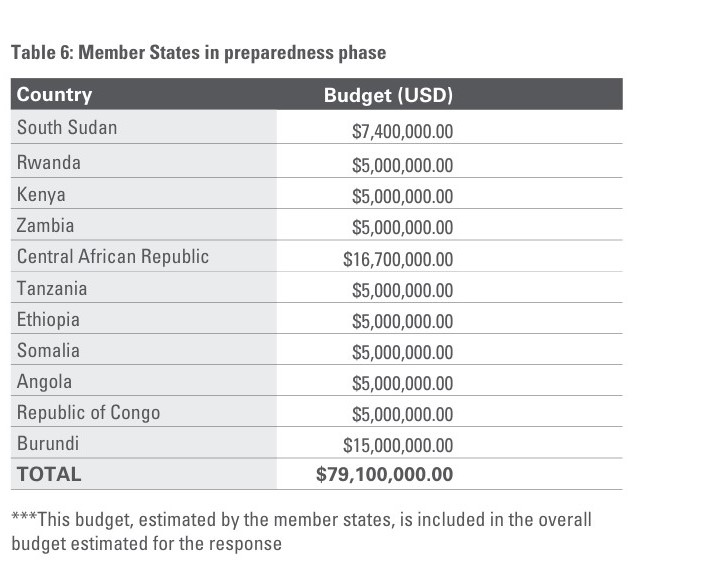
However, out of the estimated total budget, US$264,973,389.00 will be used to support the affected member states (DRC and Uganda), and US$79,100,000.00 will be used to support preparedness activities in the high-risk countries. See figure below:

The launch comes as response efforts intensify in the Democratic Republic of the Congo (DRC) and neighboring countries. Authorities are working to contain transmission while strengthening cross-border surveillance and emergency preparedness.
Coordinated Response to a Persistent Threat
Under the joint strategy, Africa CDC and WHO will support countries in strengthening emergency coordination, disease surveillance, laboratory testing, infection prevention and control, clinical care, community engagement, research, logistics, and the continuity of essential health services.
The plan complements national Ebola response strategies already launched by the governments of Uganda and the Democratic Republic of the Congo.
Speaking during the launch, WHO Director-General Tedros Adhanom Ghebreyesus emphasized the importance of coordinated action and community participation. He noted that effective contact tracing, early treatment, and outbreak control are impossible without community involvement.
“The only way to beat this outbreak is through close partnership, working together under the leadership of the affected countries in one coordinated effort, guided by a simple principle: one plan, one budget, one team.”
“Containing Ebola depends on political commitment, sustained financing, and the trust and engagement of communities. This plan places communities at the centre, because without their participation, contact tracing falters, safe care is delayed, and transmission continues.” Dr Tedros Adhanom Ghebreyesus, WHO Director-General.
Similarly, Jean Kaseya, Director-General of the Africa CDC, stressed the urgency of a united continental response. He, added that the plan provides a roadmap for rapid action to protect communities and support affected countries.
“Ebola moves fast. Africa must move faster. This joint plan gives the continent a clear path to act with speed and unity: to save lives, support the affected countries, and protect neighbouring communities. With member states, WHO, and partners, Africa CDC is turning commitment into action and resources into response for the communities at risk.”
Dr Jean Kaseya, Director-General of Africa CDC
Understanding the Bundibugyo Ebola Virus
The current outbreak is caused by the Bundibugyo virus, one of six known species within the Ebola virus family. First identified in Uganda in 2007, the Bundibugyo strain causes symptoms similar to other Ebola viruses, including fever, severe weakness, vomiting, diarrhea, and hemorrhagic complications.
Unlike the Ebola Zaire strain responsible for several major outbreaks in Africa, there are currently no licensed vaccines or therapeutics specifically approved for the Bundibugyo virus. This highlights the importance of preparedness, surveillance, infection prevention, and supportive clinical care.
According to the WHO, Ebola virus disease can have case fatality rates ranging from 25% to 90%, depending on the strain, access to healthcare, and speed of response.
Strengthening Preparedness Beyond the Outbreak
A key component of the new strategy is support for 10 priority countries considered at heightened risk due to geographic proximity, population movement, and cross-border trade. These countries are strengthening surveillance systems, laboratory capacity, emergency operations centres, and rapid response mechanisms to ensure early detection and swift containment of any imported cases.
The initiative also emphasises protecting vulnerable populations and reinforcing public health measures at border crossings and points of entry.
Health authorities have urged member states to strengthen screening procedures and maintain close coordination with neighbouring countries to reduce the risk of regional spread.
Maintaining Focus on Other Health Emergencies
The Africa CDC and WHO cautioned that the Ebola response must not come at the expense of other ongoing public health emergencies.
The plan specifically highlights the need to sustain efforts against mpox, cholera, and measles, all of which continue to pose significant threats across parts of the continent.
Health experts warn that diverting resources from existing disease control programs could reverse recent gains and increase the risk of multiple simultaneous outbreaks.
Building Long-Term Health Security
Beyond addressing the current outbreak, the joint plan is designed to strengthen Africa’s broader health security architecture.
Drawing on lessons learned from previous Ebola epidemics, the COVID-19 pandemic, and recent outbreaks of mpox and cholera, the initiative seeks to improve the continent’s capacity to prevent, detect, and respond to future health threats.
Africa CDC and WHO say the plan represents more than an emergency response—it is an investment in resilient health systems capable of protecting lives, livelihoods, and economic stability across the continent.
As implementation begins, both organisations are calling for sustained political commitment, predictable financing, and strong collaboration among governments, frontline health workers, communities, researchers, and development partners to ensure the response succeeds.
Sources
WHO-Africa CDC Ebola Response Plan
About the Author