Cynthia Goldsmith This colorized transmission electron micrograph (TEM) revealed some of the ultrastructural morphology displayed by an Ebola virus virion. See PHIL 1181 for a black and white version of this image. <b>What is Ebola hemorrhagic fever (Ebola HF)?</b><p>Ebola hemorrhagic fever (Ebola HF) is a severe, often-fatal disease in humans and nonhuman primates (monkeys, gorillas, and chimpanzees) that has appeared sporadically since its initial recognition in 1976.<p>The disease is caused by infection with Ebola virus, named after a river in the Democratic Republic of the Congo (formerly Zaire) in Africa, where it was first recognized. The virus is one of two members of a family of RNA viruses called the Filoviridae. There are four identified subtypes of Ebola virus. Three of the four have caused disease in humans: Ebola-Zaire, Ebola-Sudan, and Ebola-Ivory Coast. The fourth, Ebola-Reston, has caused disease in nonhuman primates, but not in humans.
When the Africa CDC and the World Health Organisation (WHO) launched their joint Ebola preparedness and response plan, they also unveiled one of the largest coordinated outbreak financing frameworks in Africa in recent years. The six-month strategy aims to mobilise US$517.7 million to support outbreak response and preparedness activities across affected and high-risk countries from June to November 2026.
The funding package reflects both the scale of the current threat and the costs associated with preventing Ebola from spreading across borders.

Read: Africa CDC and WHO Unite for Ebola Response Plan
DRC Receives Largest Share
The Democratic Republic of the Congo (DRC), which remains at the centre of the outbreak response, will receive the largest allocation. According to the plan, US$240.3 million has been allocated for response activities in the DRC. Uganda, another affected country, is expected to receive US$24.7 million. Together, these allocations account for more than half of the response funding currently outlined in the strategy.
Health authorities say the higher allocation reflects the operational demands of surveillance, treatment, laboratory services, logistics, and workforce deployment in areas experiencing active transmission.

Preparedness Funding Targets High-Risk Countries
The plan also includes US$79.1 million in preparedness funding for neighbouring and high-risk countries.
The Central African Republic will receive US$16.7 million, while Burundi has been allocated US$15 million.
South Sudan is expected to receive US$7.4 million.
Kenya, Rwanda, Tanzania, Ethiopia, Somalia, Angola, the Republic of the Congo, and Zambia have each been allocated US$5 million to strengthen preparedness activities.
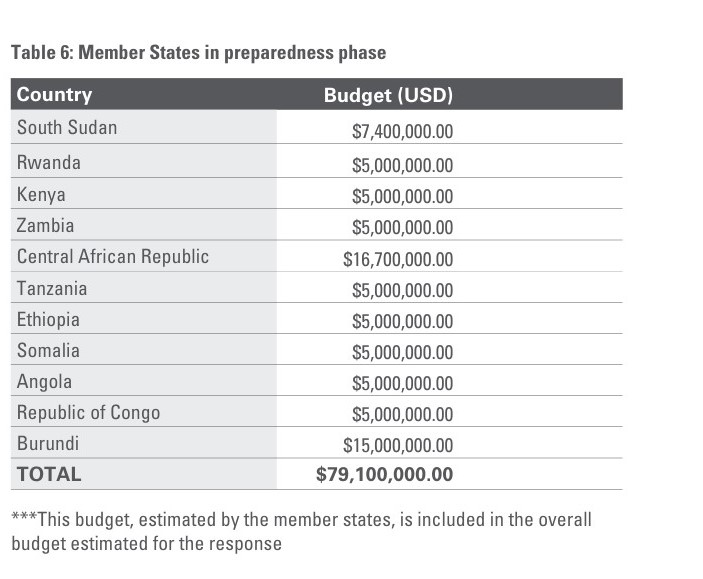
These investments are intended to improve surveillance, laboratory capacity, border screening, and emergency response readiness before outbreaks occur.
Logistics and Workforce Deployment
A closer look at the budget reveals that logistics and operational support account for the largest share of planned spending. Nearly US$130 million has been allocated to operations, logistics, nutrition support, and workforce deployment.
Public health experts note that outbreak control depends heavily on transportation systems, field operations, emergency staffing, and the movement of medical supplies.
Without these operational components, even well-designed response plans can struggle to deliver results.
Investment in Research and Clinical Care
The second-largest allocation supports research, knowledge management, and medical countermeasures, receiving approximately US$67.7 million.
Case management and clinical care will receive US$66.5 million, while surveillance and preparedness activities account for US$66.3 million.
Additional investments include US$49.1 million for infection prevention, water, sanitation, and hygiene measures and safe burial practices.
Risk communication and community engagement activities have been allocated US$46.6 million.
Health officials say these investments reflect lessons learned from previous Ebola outbreaks, where delayed diagnosis, weak community engagement, and inadequate infection control contributed to transmission.
Also Read: How Counterfeit Antibiotics Fuel Antimicrobial Resistance in Africa
Funding Mobilization For Ebola in Africa
While substantial funding requirements have been identified, not all resources have yet been secured. Approximately US$173.6 million remains dependent on partner contributions and ongoing resource mobilization efforts.
The Africa CDC and WHO have called on governments, donors, and development partners to support the response and ensure the timely implementation of critical activities.
Health economists warn that delayed financing can increase overall response costs by allowing outbreaks to expand before interventions are fully deployed.
Read Also: END TUBERCULOSIS BY 2030: A DOABLE COURSE OR POLICY RHETORIC IN RURAL COMMUNITIES?
Investing Early to Prevent Larger Crises
The response plan reflects a growing recognition that investing early in outbreak control is more effective and less expensive than responding to widespread transmission. Directing resources toward preparedness, surveillance, community engagement, and health system strengthening, the Africa CDC and WHO hope to contain the current outbreak while reducing future risks.
As fundraising efforts continue, the success of the plan will depend not only on the amount of money mobilized but also on how quickly resources reach frontline responders and the vulnerable. communities.
For health authorities across Africa, the goal is to stop the outbreak before it grows and strengthen the continent’s capacity to respond to the next public health threat.
About the Author