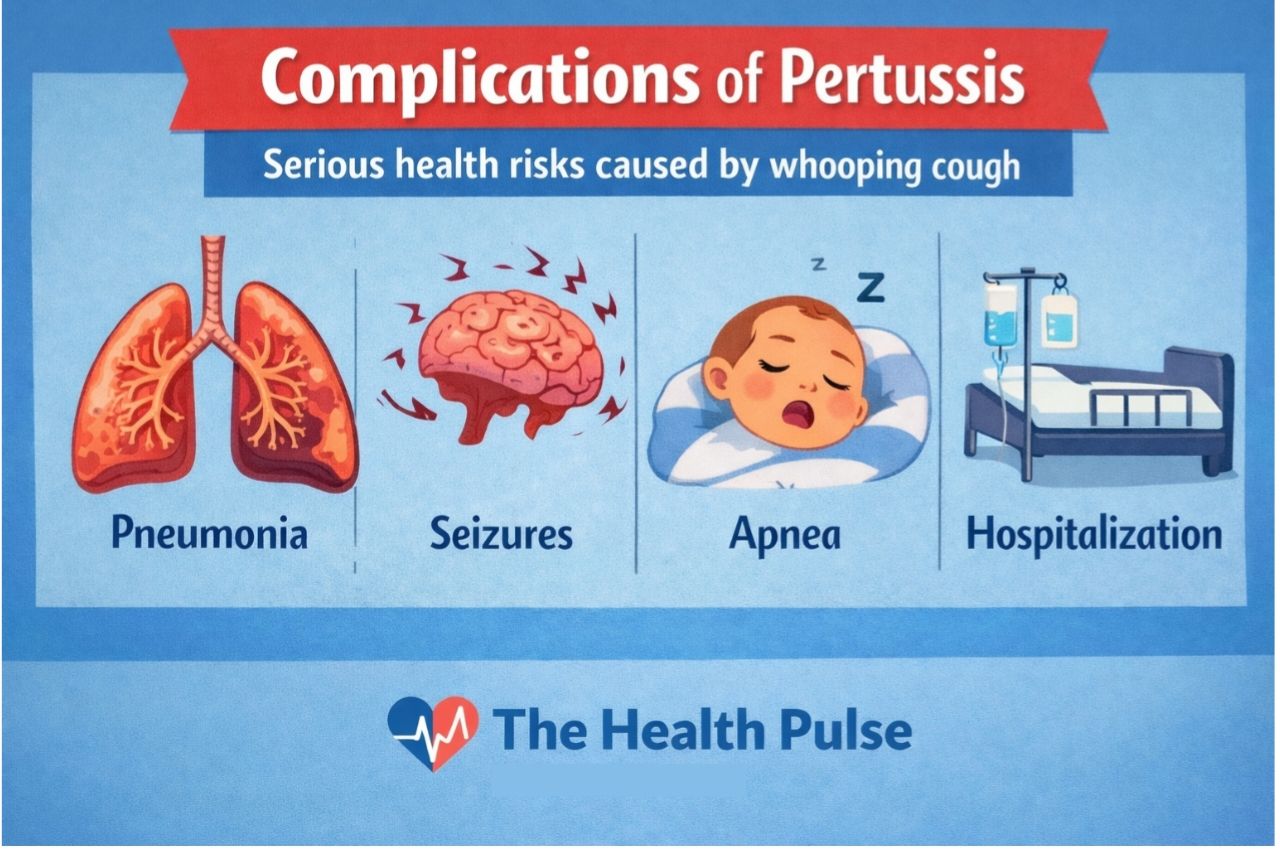
Whooping cough is not just a childhood illness. it’s a serious, vaccine preventable disease that still affects thousands of people every year. These explainer, breaks down what pertussis is, how it spreads, its warning signs, and why vaccination still matters for children and adults. Read, and learn, how to protect yourself and your loved ones.
What is Pertussis?
Pertussis, also known as whooping cough, is a respiratory infection caused by a fastidious, gram-negative bacterium called Bordetella pertussis (1). It is coined from the Latin word ‘per-tussis’, where ‘per’ means ‘much’ or ‘excessive’ and ‘tussis’ means ‘cough’. And the English word is called “whooping cough”(2).
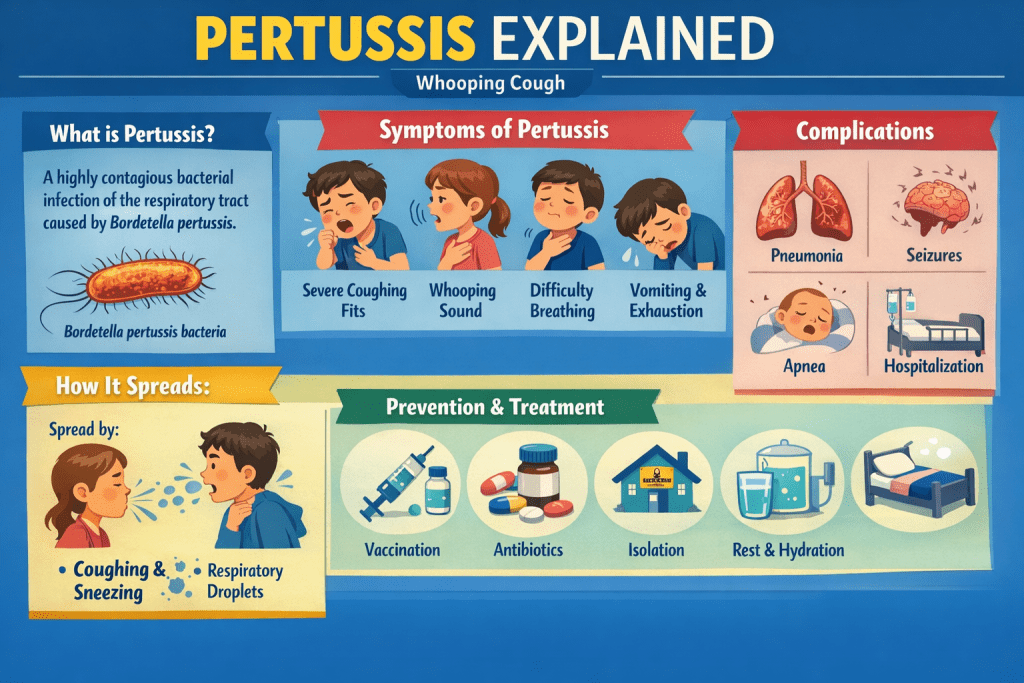
Infographic explaining Pertussis
This infectious disease affects children from a few months of age to six years of age, though adults and adolescents are not spared from it. In addition to being a major reservoir for B. pertussis, adolescents, adults, and older school-age children are frequently the source of infection for newborns(1)(2).
Despite several years of vaccination, pertussis is still a global health challenge. But there was a positive decline in the incidence of pertussis by the inclusion of diphtheria, tetanus, and whole-cell pertussis (DTwP) vaccines in the World Health Organization (WHO) Expanded Program on Immunization (EPI) in 1974. However, a phenomenon known as the pertussis resurgence was said to occur in high-income, middle-income, and low-income countries in the 1980s(3).
According to the CDC, during the 1980s, pertussis reports began increasing gradually, leading to a peak in 2012 with 48,277 reported cases. Since then, reported cases remained elevated until the start of the COVID-19 pandemic in 2020. Pertussis cases have also been decreasing since November 2024, when they peaked. However, preliminary case report numbers remain higher in 2025 than before the epidemic. Pertussis has no specific seasonal trend; cases tend to increase in the summer and fall(4).
Recent Epidemiological Update on Pertussis
In the year 2024, a total of 977000 cases of pertussis were reported to the World Health Organization (WHO), showing a 5.8-fold increase compared to the number reported in 2024(5)It was said that there was a low report of pertussis cases immediately following the COVID-19 pandemic. However, the United States is said to have an increase in the number of cases of about 10000 cases each year(4).
The World Health Organization (WHO) recorded 941,565 cases of pertussis worldwide in 2024. The annual number of new cases of pertussis worldwide decreased by 40.98% between 1990 and 2019. According to a 2014 study, there are an estimated 24.1 million cases of pertussis and 160,700 deaths in children under five worldwide(6).
How Pertussis Spreads
Pertussis spreads through respiratory droplets from person to person. When an infected person coughs, sneezes, or even breathes slowly too close to others, they release respiratory droplets in the air with bacteria in them.This will spread when other people breathe this air in, especially when they live together in a closed area(7).
This risk factor can equally predispose someone to acquiring pertussis, and it includes: (8)
- Pregnancy
- Epidemic exposure
- Lack of immunization
- Close contact with an infected individual.
It has an incubation period of 1 to 3 weeks.
Signs and Symptoms Of Pertussis
Pertussis usually develops in three main stages, with symptoms changing over time(8):
1. Early Stage (Catarrhal Phase); First 1 to 2 Weeks.
- Begins like a common cold or mild flu
- Runny nose and sneezing
- Mild fever
- Tiredness and general weakness
- Red or watery eyes.
This is the most contagious stage of the illness.
2. Severe Cough Stage (Paroxysmal Phase)
- Frequent, intense coughing fits
- Rapid coughing followed by a deep breath that makes a “whooping” sound
- Coughing episodes may be triggered by cold air, loud noise, or physical activity
- Attacks often happen more at night
- Vomiting after coughing
- Brief pauses in breathing (especially in infants)
- Bluish lips or face during severe attacks
- Sweating and extreme tiredness after coughing
- Possible fainting after intense coughing
Paroxysmal attacks occur frequently at night.
3. Recovery Stage (Convalescent Phase)
- Cough slowly improves but may last for several weeks or months
- Cough may return when exposed to dust, smoke, or new infections.
- Gradual return to normal breathing and energy levels.
Special Features in Infants and Young Children
- Symptoms may be different and harder to recognise
- Fever may be absent
- Fast breathing
- Repeated pauses in breathing (apnea)
- Bluish skin or lips (cyanosis)
- Slow heart rate during episodes
- Weak or absent “whoop” sound in very young babies.
Pertussis Complications
According to the Centers for Disease Control and Prevention. Pertussis complications can include:
- Anorexia
- Dehydration
- Difficulty sleeping
- Epistaxis
- Hernias
- Otitis media
- Syncope
- Weight loss
- Urinary incontinence.
More severe complications can include:
- Apnea
- Encephalopathy (due to hypoxia from coughing or from a toxin)
- Death
- Pneumonia
- Pneumothorax
- Rectal prolapse
- Refractory pulmonary hypertension (in infants)
- Rib fractures from severe coughingSeizures/convulsions
- Subdural haematomas.
It is said that infants younger than 12 months of age are more susceptible to complications of pertussis if they are unvaccinated or incompletely vaccinated. Adults and adolescents are less likely to have pertussis complications if they are vaccinated (9).
Diagnosis and Treatment of Pertussis
Diagnosing pertussis can be difficult, as it often presents as other respiratory infections. Therefore, healthcare providers can diagnose whooping cough if they take a good history of the patient, do a good physical examination, perform a laboratory test of the mucus sample, and lastly, do a blood test (9).
In treating pertussis, it is largely supportive, such as oxygenation, suctioning, hydration, and avoidance of respiratory irritants. The use of parenteral nutrition may be needed. Patients are often hospitalised if they have pneumonia, hypoxia, central nervous system complications, or are unable to tolerate nutrition and hydration by mouth (8).
Unless given before the onset of the paroxysmal stage, antibiotics such as macrolides (erythromycin, clarithromycin, and azithromycin) can shorten the period of transmissibility but are unlikely to lessen the intensity or length of the illness (5).
Clinical Management
In instances where pertussis has been detected, respiratory isolation is advised. Newborns and small children, particularly unimmunized newborns, should not be around suspected or confirmed cases until at least five days after patients have finished taking antibiotics. When paroxysmal coughing starts, suspected cases who are not taking antibiotics should be kept in isolation for three weeks, or until the cough goes away (5)(8).
Preventive Strategies
Vaccination
The CDC recommends that one of the best ways to fight pertussis is for everyone to receive the whooping cough vaccine (9). Vaccinating pregnant women will also help to prevent the disease in infants too young to be vaccinated (10).
Antibiotics
Postexposure antimicrobial prophylaxis (PEP) is recommended for those who have been exposed to the harmful bacteria by being around someone who has whooping cough, to prevent them from getting sick (9)(10).
Good hygiene
Practising good hygiene, such as proper hand washing and covering your mouth and nose with a tissue or your elbow after coughing and sneezing, will help to prevent the spread of bacteria (9).
Conclusion
Pertussis, also known as whooping cough, is a vaccine-preventable disease and a global health challenge caused by the bacterium Bordetella pertussis. It spreads easily through airborne droplets produced when an infected person coughs or sneezes. With early detection and proper immunisation, the incidence of pertussis can be significantly reduced, protecting both individuals and communities.
References
- CDC. Chapter 16: Pertussis. In: Epidemiology and Prevention of Vaccine-Preventable Diseases (The Pink Book). 14th ed. Atlanta (GA): Centers for Disease Control and Prevention (US); 2024 Apr 12 [cited 2026 Feb 7]. Available from:https://www.cdc.gov/pinkbook/hcp/table-of-contents/chapter-16-pertussis.html
- Galassi FM, Varotto E, Martini M. The history of pertussis: from an ancient scourge to a contemporary health burden. J Prev Med Hyg. 2024;64(4):E507–E511. doi:10.15167/2421-4248/jpmh2023.64.4.3163. PMID: 38379743. Available from: https://pmc.ncbi.nlm.nih.gov/articles/PMC10876032/
- Wang S, Zhang S, Liu J. Resurgence of pertussis: Epidemiological trends, contributing factors, challenges, and recommendations for vaccination and surveillance. Hum Vaccin Immunother. 2025 Jun 9;21(1):2513729. doi:10.1080/21645515.2025.2513729. PMID: 40491090; PMCID: PMC12153400. Available from: https://pmc.ncbi.nlm.nih.gov/articles/PMC12153400/
- Centers for Disease Control and Prevention. Pertussis surveillance and trends. Atlanta (GA): CDC; Dec 2, 2025 [cited 2026 Feb 7]. Available from: https://www.cdc.gov/pertussis/php/surveillance/index.html
- Pan American Health Organization/World Health Organization. Epidemiological Update: Pertussis (Whooping Cough) in the Americas Region. 8 December 2025. Washington, D.C.: PAHO/WHO; 2025 [ Accessed 7th February 2026]. Available from: https://acrobat.adobe.com/id/urn:aaid:sc:EU:ff083754-75f5-4198-bf46-4ff19a3924de
- Centers for Disease Control and Prevention. Pertussis in other countries: global trends and impact. Atlanta (GA): CDC; Dec 2, 2025 [cited 2026 Feb 7]. Available from: https://www.cdc.gov/pertussis/php/global/index.htmlcdc_generic_section_2-trends
- Centers for Disease Control and Prevention. About pertussis (whooping cough). Atlanta (GA): CDC; Nov 26, 2025 [cited 2026 Feb 7]. Available from: https://www.cdc.gov/pertussis/about/index.html
- Lauria AM, Zabbo CP. Pertussis. In: StatPearls [Internet]. Treasure Island (FL): StatPearls Publishing; 2025 Jan [cited 2026 Feb 7]. Available from: https://www.ncbi.nlm.nih.gov/books/NBK519008/
- Centers for Disease Control and Prevention. Clinical overview of pertussis (whooping cough). Atlanta (GA): CDC; Dec 1, 2025 [cited 2026 Feb 7]. Available from: https://www.cdc.gov/pertussis/hcp/clinical-signs/index.html
- World Health Organization. Pertussis (whooping cough). Geneva: WHO; [updated 2025; cited 2026 Feb 7]. Available from: https://www.who.int/health-topics/pertussis
About the Author