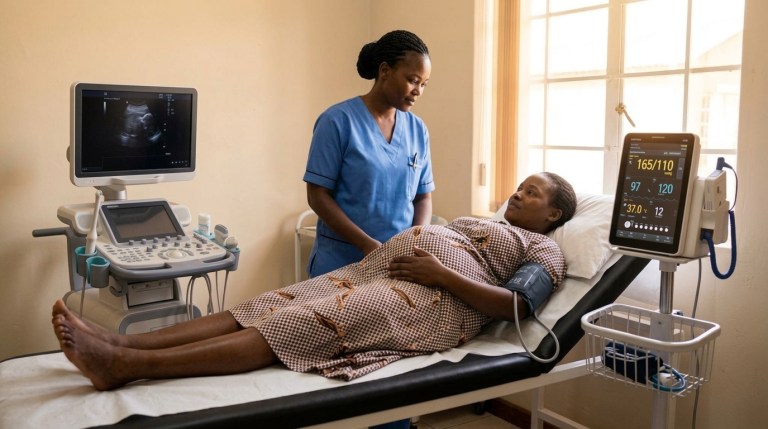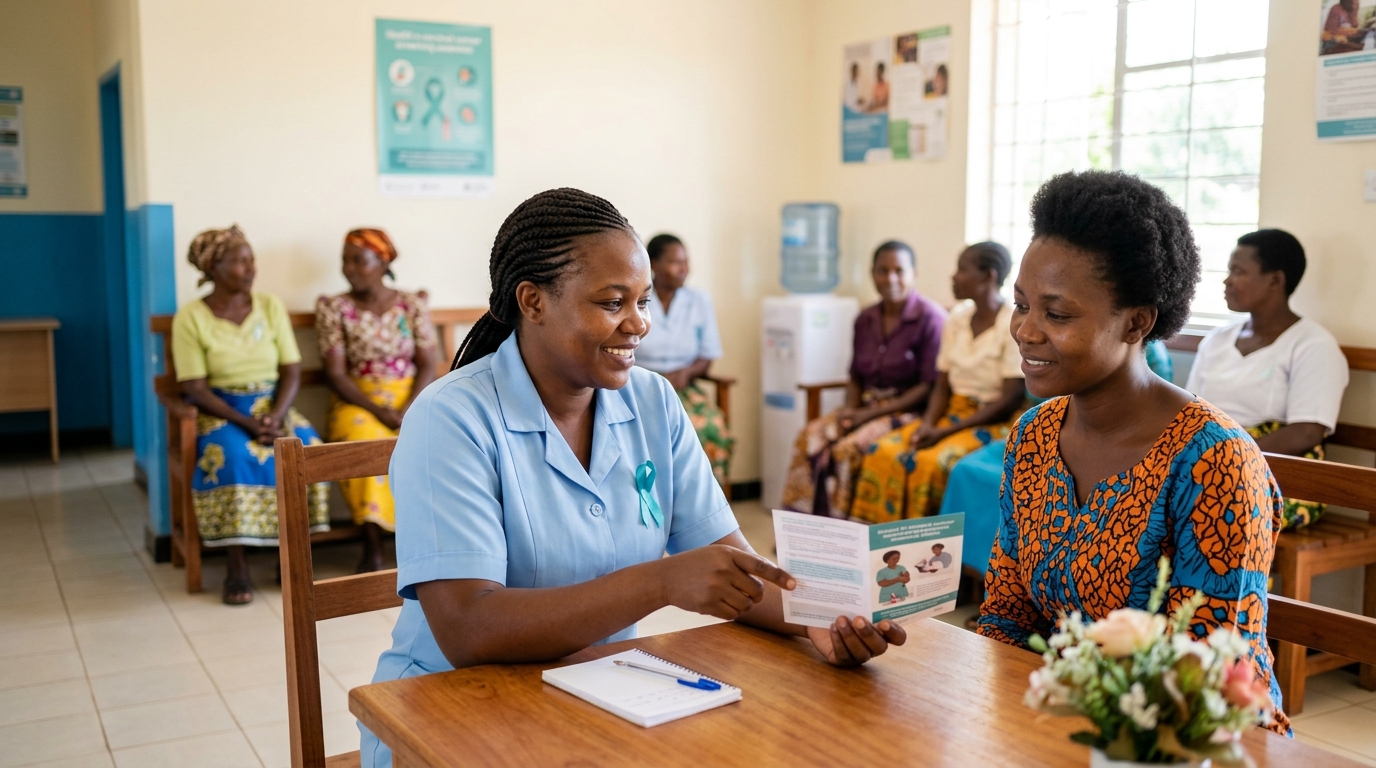
A nurse counselling a woman about cervical cancer screening at a clinic in Africa. Image generated with AI (Nano Banana).
Cervical cancer is one of the most preventable cancers, yet women in sub-Saharan Africa die from it at higher rates than women anywhere else in the world[8][10]. In 2020, cervical cancer was the fourth most common cancer in women globally, but the burden fell disproportionately on low- and middle-income countries, with sub-Saharan Africa carrying the highest age-standardized incidence and mortality rates[8]. In high-income countries, organised vaccination and screening programmes have reduced cases and deaths rapidly.
Across sub-Saharan Africa, women still face low screening coverage, gaps in vaccine access, late diagnosis and limited access to treatment. The tools to prevent this disease exist. The question is why they have not reached the women who need them most.
Cervical Cancer in Africa: How Many Women Are Affected?
Cervical cancer takes the lives of tens of thousands of women across Africa every year. In 2020, the continent recorded an estimated 119,284 new cases and 81,687 deaths[7]. In sub-Saharan Africa, it is the leading cause of cancer death among women[15]. Rates differ widely between countries. In Malawi and Zambia, age-standardised incidence exceeded 65 per 100,000 women in 2020[10]. WHO considers cervical cancer eliminated as a public health problem when a country’s incidence falls to 4 cases or fewer per 100,000 women-years[14]. Many high-income countries are moving toward that threshold, while recent analyses show Africa’s burden is rising[6]. Without stronger prevention and treatment systems, most future deaths are projected to occur in sub-Saharan Africa[15].
Why Cervical Cancer Is Preventable: HPV Vaccine and Screening
Cervical cancer is one of the most preventable cancers. Its main cause is known, and its precancerous stages can be detected and treated. Persistent infection with high-risk human papillomavirus (HPV) causes nearly all cases, with HPV-16 and HPV-18 responsible for about 76% globally[13]. The disease also develops slowly. It usually takes 15 to 20 years in women with a healthy immune system, and 5 to 10 years in women with a weakened immune system, such as untreated HIV[13].
This gives two points to intervene. The first is the HPV vaccine, which prevents infection. The second is screening for HPV or precancerous lesions, followed by timely treatment[4]. When programs are well targeted and linked to treatment, screening can reduce cervical cancer incidence by 70% to 80%[7].
Self-sampling HPV tests offer a practical way to reach women who do not attend clinics. Randomized trials in sub-Saharan Africa found higher screening uptake with self-sampling than with standard clinician-based screening[11].
Why African Women Are Still Dying From Cervical Cancer
1. Low screening coverage
Most women are never screened for cervical cancer. Across 28 sub-Saharan African countries, only 14% of women aged 30 to 49 had ever been screened in 2020[15]. Coverage varies widely, from 2% in Côte d’Ivoire to 56% in South Africa[9].
2. Late diagnosis
Without screening, many women are diagnosed only after symptoms appear. More than half of cases in Africa, a pooled 53.3%, are found at stage III or IV, when treatment is harder and survival is lower[2]. Median survival across African studies was 24 months[2].
3. HPV vaccine gaps
In 2020, two-thirds of sub-Saharan African countries had no national HPV vaccination programme, and only about 20% of girls were fully vaccinated[15].Even where programmes exist, communication problems, supply issues, and sociocultural concerns slow uptake.
4. Limited access to care
Even when a woman wants to be screened, the service may not exist near her. Many countries lack enough trained staff, screening centres, equipment, and referral systems[4]. Treatment is also hard to find. Surgery and radiotherapy are unavailable or unaffordable in many low-resource countries[16]. Funding is part of the problem. Cervical cancer control in low- and middle-income countries received less than 10% of projected need for 2019 to 2030[10].
5. Cost and distance
Where services exist, many women still cannot reach them. They report long journeys, transport costs, and consultation fees as reasons for staying away[7]. Screening uptake is lower in rural and poorer households[1].
6. Stigma and low awareness
Many women do not know the signs of cervical cancer, the benefits of screening, or where to go for it. Fear of results, fear of pain, myths, and stigma linked to sexuality also keep women away. Some skip screening because they feel healthy[5].
7. HIV
Women living with HIV have about six times the risk of cervical cancer[15]. Yet, a six-country population study found that fewer than one in five had ever been screened[1]. Screening is especially low among younger, poorer, rural, and less-educated women living with HIV[16].
What Is Working: Proven Cervical Cancer Prevention in Africa
Some approaches are already working and can be copied. Rwanda shows what organised delivery can achieve. In 2011, its school-based HPV vaccination programme reached 93% of eligible girls with a full three-dose course, helped by community members who identified girls who were absent from school or not enrolled[3].
Self-sampling HPV kits raise screening uptake across sub-Saharan Africa, especially when offered at home, at work, or at nearby community sites[11]. Community health worker outreach, task-sharing, and screening inside HIV clinics also bring services closer to women through channels they already trust[9].
WHO’s 2030 targets set the benchmark. They call for 90% of girls fully vaccinated by age 15, 70% of women screened with a high-performance test by ages 35 and 45, and 90% of women with cervical disease treated[14].
Cervical Cancer Prevention: Vaccination, Screening and Early Care
- Early cervical cancer often causes no symptoms, so women should not wait to feel unwell. They should ask their clinic which screening it offers, such as HPV testing, VIA (Visual Inspection with Acetic Acid), Pap testing or self-sampling. Self-sampling is acceptable to many women, and it can raise uptake where clinic-based screening is hard to reach[11][5]. Women living with HIV face a much higher risk[15], so they should ask for regular screening. HIV care visits are a good point to arrange for it[1].
- Parents and guardians should vaccinate girls aged 9 to 14, because WHO treats this age group as the priority. The vaccine works best before a girl becomes sexually active, so it protects her before she is likely to be exposed to HPV, and it is highly effective at preventing cervical cancer and other HPV-related cancers[13].
- Women and the people close to them should also know the warning signs of cervical cancer, because the disease can be cured when found and treated early[13]. These signs include unusual discharge and bleeding between periods or after menopause. They also include bleeding or pain during sex. Women who notice any of them should seek medical advice.
Conclusion
Cervical cancer in Africa persists because the tools to prevent it are unevenly distributed. The HPV vaccine, cervical cancer screening, early diagnosis, and treatment all exist, yet, too many women cannot reach them[15]. Deaths stay high where women; go unscreened, are diagnosed late, face cost and distance barriers, or live with HIV without regular screening. Closing these gaps depends on delivering proven prevention and care at scale.
References
- Alpar, A., Ndiaye, C., Guillaume, D., Limaye, R., & Rosen, J. (2025). High unmet needs for cervical cancer screening among women living with HIV in six African countries: A population-based study. *International journal of STD & AIDS, 36*, 397 – 405. https://doi.org/10.1177/09564624251315787
- Anakwenze, C., Kalra, A., Lumley, C., Chinniah, G., Munsell, M., Rajan, T., Moorkanat, G., Mehta, P., Ewongwo, A., Valle, L., Litcher, K., Geng, Y., & Grover, S. (2025). Cervical cancer stage distribution and survival outcomes in Africa: a systematic review and meta-analysis.. *International journal of gynecological cancer: official journal of the International Gynecological Cancer Society, 35 1*, 100008. https://doi.org/10.1016/j.ijgc.2024.100008
- Binagwaho, A., Wagner, C. M., Gatera, M., Karema, C., Nutt, C. T., & Ngabo, F. (2012). Achieving high coverage in Rwanda’s national human papillomavirus vaccination programme. Bulletin of the World Health Organization, 90(8), 623–628. https://pmc.ncbi.nlm.nih.gov/articles/PMC3417784/
- Daniels-Donkor, S., & Marryat, L. (2026). Health system barriers and facilitators influencing the uptake of cervical cancer screening among women in sub-Saharan Africa: systematic review and meta-synthesis. *BMC Health Services Research, 26*. https://doi.org/10.1186/s12913-026-14003-5
- Dzobo, M., Dzinamarira, T., Jaya, Z., Kgarosi, K., & Mashamba-Thompson, T. (2024). Experiences and perspectives regarding human papillomavirus self-sampling in sub-Saharan Africa: A systematic review of qualitative evidence. *Heliyon, 10*. https://doi.org/10.1016/j.heliyon.2024.e32926
- Huang, Y.-D., Chen, S., Ren, S., Zhao, J.-W., Wang, Z.-H., Lu, Z.-C., Qian, W., Wang, J., Zhou, T., Wang, Y.-F., Jiao, Z., Yuan, C., Hou, Y., Liu, D., Liu, Z., Xu, A.-M., Liu, L., Hong, Q., & Zhang, L. (2026). Diverging Cervical Cancer Burden in Africa in the Context of WHO’s Elimination Strategy: Insights From GBD 2023. *Med Research*. https://doi.org/10.1002/mdr2.70063
- Mantula, F., Toefy, Y., & Sewram, V. (2024). Barriers to cervical cancer screening in Africa: a systematic review. *BMC Public Health, 24*. https://doi.org/10.1186/s12889-024-17842-1
- Momenimovahed, Z., Mazidimoradi, A., Maroofi, P., Allahqoli, L., Salehiniya, H., & Alkatout, I. (2022). Global, regional and national burden, incidence, and mortality of cervical cancer. *Cancer Reports, 6*. https://doi.org/10.1002/cnr2.1756
- Rivero-Mendoza, D., Gjoka, K., Singh, L., Adkins, L., Bylund, C. L., Staras, S., Salloum, R., Shenkman, E., Egbounye, N. C., & Mkuu, R. (2025). Health System Strategies to Improve the Uptake of Cervical Cancer Screening in Sub-Saharan Africa: A Scoping Systematic Review. *Health promotion practice, 27*, 576 – 599. https://doi.org/10.1177/15248399251370668
- Singh, D., Vignat, J., Lorenzoni, V., Eslahi, M., Ginsburg, O., Lauby-Secretan, B., Arbyn, M., Basu, P., Bray, F., & Vaccarella, S. (2022). Global estimates of incidence and mortality of cervical cancer in 2020: a baseline analysis of the WHO Global Cervical Cancer Elimination Initiative. *The Lancet. Global Health, 11*, e197 – e206. https://doi.org/10.1016/s2214-109x(22)00501-0
- Tesfahunei, H., Ghebreyesus, M. S., Assefa, D., Zeleke, E. D., Acam, J., Joseph, M., Getachew, E., Kajogoo, V., Zegeye, B. H., & Manyazewal, T. (2021). Human papillomavirus self-sampling versus standard clinician-sampling for cervical cancer screening in sub-Saharan Africa: a systematic review and meta-analysis of randomized controlled trials. *Infectious Agents and Cancer, 16*. https://doi.org/10.1186/s13027-021-00380-5
- World Health Organization Regional Office for Africa. (2023, October 24). Nigeria to vaccinate 7.7 million girls against leading cause of cervical cancer. https://www.afro.who.int/fr/node/18403
- World Health Organization. (2026.). Cervical cancer [Fact sheet]. https://www.who.int/news-room/fact-sheets/detail/cervical-cancer
- World Health Organization. (2020). Global strategy to accelerate the elimination of cervical cancer as a public health problem. https://www.who.int/publications/i/item/9789240014107.
- Yang, L., Boily, M., Rönn, M., Obiri-Yeboah, D., Morhason-Bello, I., Méda, N., Lompo, O., Mayaud, P., Pickles, M., Brisson, M., Hodgins, C., Delany-Moretlwe, S., & Maheu-Giroux, M. (2023). Regional and country-level trends in cervical cancer screening coverage in sub-Saharan Africa: A systematic analysis of population-based surveys (2000–2020). *PLOS Medicine, 20*. https://doi.org/10.1371/journal.pmed.1004143
- Yirsaw, A. N., Nigusie, A., Andualem, F., Getachew, E., Getachew, D., Tareke, A. A., Mihret, M. S., & Lakew, G. (2024). Cervical cancer screening utilization and associated factors among women living with HIV in Ethiopia, 2024: systematic review and meta-analysis. *BMC Women’s Health, 24*. https://doi.org/10.1186/s12905-024-03362-y
About the Author