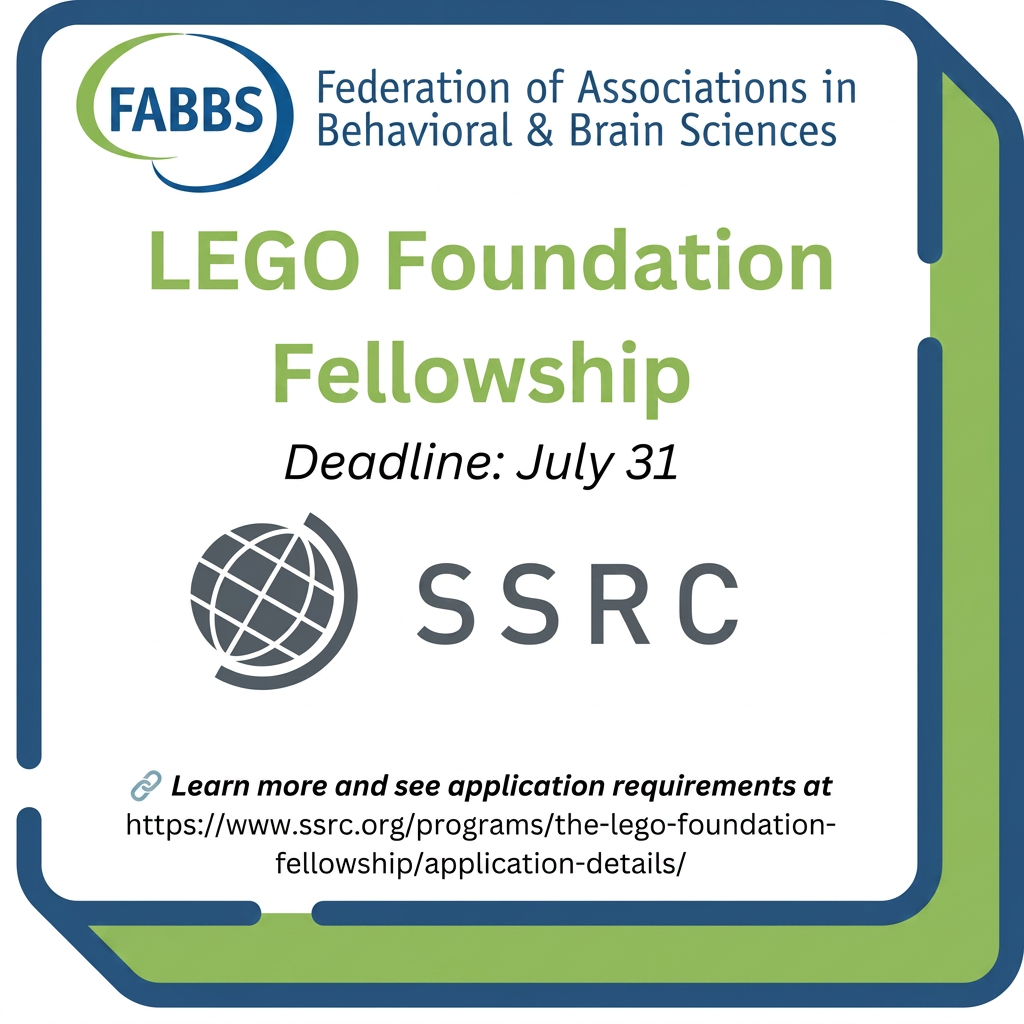
Organisation: Social Science Research Council
Duration: February 1, 2027 to December 31, 2029
Number of the fellowship: up to 10
Funding: USD 300,000 over 3 years
Application deadline: July 31, 2026
OVERVIEW
The LEGO Foundation invites applications for the LEGO Foundation Fellowship, a global research fellowship for early- and mid-career researchers whose work can strengthen understanding of how children thrive across diverse contexts.The LEGO Foundation Fellowship supports researchers with a clear line of inquiry related to children’s thriving.
The LEGO Foundation Fellowship welcomes research proposals that advance understanding of children’s thriving through one of the following three themes: the youngest children in crisis and conflict settings; inclusion and wellbeing of neurodivergent children; and children’s learning and development in an AI-enabled world. Applicants may explore the role of play where it is relevant to the research question. The consideration of play is optional and not a condition of eligibility
The LEGO Foundation Fellowship focuses on the realities children face, addressing barriers, supporting learners of all abilities, and responding where children are touched by crises and humanitarian needs. By investing in the holistic ecosystems that shape childhood — from families and schools to communities and entire societies — The LEGO Foundation Fellowship works to strengthen access to education, creativity, and play. This includes both grantmaking and impact investments supporting solutions that can grow and reach more children over time.
BENEFITS
- Flexible research funding of USD 300,000 over three years, inclusive of 15% indirect cost.
- Funding administered by the fellow’s host institution.
- Support for eligible research costs including research personnel, professional travel, equipment, dissemination, trainee supporter, and related project cost.
- Access to a cohort of fellows working on children’s thriving across disciplines and contexts
- Opportunity for exchanging with other fellows, researchers, practitioners, and partners including at convenings hosted by the LEGO Foundation.
- Media channel to disseminate your work to a broader audience.
- Recognition as part of the LEGO Foundation’s network.
RESPONISIBILITIES
- Dedicate sustained time to research agenda proposed in their application
- Participate in fellowship convenings, including annual meetings and virtual cohort sessions.
- Share work progress and contribute constructively to exchange with other fellows.
- Submit annual progress updates and a final report.
- Acknowledge fellowship support in publication, presentation and other outputs.
- Take part in LEGO Foundation coverage of the fellowship and their work , and dissemination of their research.
- Follow relevant ethical, safeguarding, data protection, and institutional requirements.
QUALIFICATIONS
- Hold a PhD or equivalent research doctorate by July 31, 2026
- Have received their PhD no earlier than January 1, 2016 , subject to any approved career-break policy.
- Be employed by a university or research institute at the start of the fellowship.
- Submit an individual application.
- Propose work that aligns with one or more fellowship themes.
SELECTION CRITERIA
- Alignment with the fellowship themes: The proposed work clearly aligns with one of the three fellowship themes and shows how it would advance understanding of children’s thriving.
- Clarity and strength of the proposed work: The application presents a clear question, problem, or area of inquiry. It explains why the work matters, what gap it addresses, and what can be meaningfully advanced during the fellowship period.
- Applicant readiness: The applicant demonstrates the experience, judgment, and capacity to carry the work forward. Reviewers will consider the applicant’s achievements and potential relative to career stage, context, and opportunity.
- Approach and feasibility: The proposed approach is appropriate to the question, context, and population. The application shows a realistic understanding of the work involved, including anticipated challenges and how they may be addressed.
- Research quality: The proposed work is rigorous, methodologically sound, and can be meaningfully advanced during the fellowship period. The applicant presents a realistic plan for the fellowship period, including methods, partnerships, timeline, ethics, and risks.
- Field context and contribution: The application situates the proposed work in relation to relevant research, debates, communities, or areas of practice. It explains what the work could contribute to others working on related questions.
- Fellowship fit and cohort contribution: The applicant explains why this fellowship is timely for their work, how participation could strengthen the proposed research, and how they would contribute to exchange with other fellows.
APPLICATION MATERIAL
- A standard online application form
- A resume or CV (two page limit)
- A research abstract (250 word limit)
- A personal statement (500 word limit) that explains a) your inspiration for pursuing research into childhood development; b) how the proposed research will contribute to scholarly knowledge on the topic; and c) how the proposed research will support your capacity for leadership in moving discovery into practice.
- A research proposal (5 page limit) that includes:
- Relevance. Clearly articulate the research question you will answer.
- Original contribution. Describe the practical implications of the proposed research. How will your research findings be useful to other scholars, practitioners, and/or policy makers?
- Methods. Describe the methods you will use for your research, the type of data you will collect, how you will analyze these data, and steps you will take to ensure that the data and analysis are reliable. Explain why you have chosen the proposed approach for the given question. If your research includes human subjects, you must include your plans for obtaining IRB approval.
- Feasibility. What practical, conceptual, or logistical challenges do you anticipate? How do you plan to address them during the fellowship term
- Work to date. A brief description of related research work done to date, noting any preliminary analysis informing the proposed research.
- Completed budget and budget justification templates
- A selected bibliography (2 page limit) relevant to the proposed research.
HOW TO APPLY
For more information visit Social Science Research Council official page
About the Author