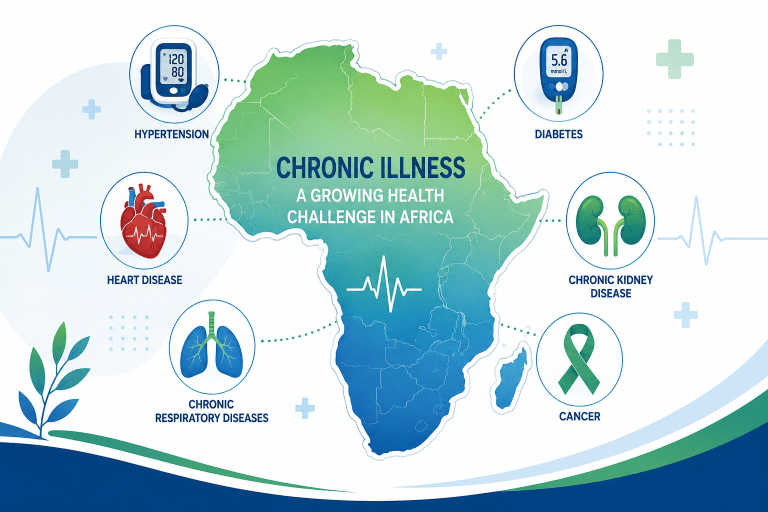
An AI generated illustration representing medication adherence challenges among older adults living with HIV in Africa.
Human Immunodeficiency Virus (HIV) remains a significant global health challenge. In 2024, 40.8 million people were living with HIV worldwide (1). Africa carries the highest burden with 26.3 million people living with HIV, representing 64 percent of the global total (1). Of these, 21.7 million Africans were receiving Antiretroviral Therapy (ART) in 2024 (1).
The availability of ART has significantly improved survival rates among people living with HIV. This success has resulted in an increasing number of older adults living with the virus. Between 2000 and 2016, the number of adults aged 50 years and older living with HIV in sub-Saharan Africa doubled (2). By 2040, one in four people living with HIV in Africa will be aged 50 years or older (2).
However, older adults living with HIV face unique adherence challenges. Many manage five to ten medications simultaneously. Social isolation increases when partners die, and stigma prevents disclosure to family members even after decades of living with HIV. Adherence to HIV medications declines with age due to medical, social, and structural factors. This case study examines the five primary drivers of non-adherence in the aging HIV-positive population.

1. The Polypharmacy Problem

Polypharmacy is the use of five or more medications at the same time. Among older adults living with HIV in Africa, polypharmacy is common.
A study in Uganda found that 15.3 percent of HIV-positive adults aged 50 years and older were taking four or more non-HIV medications in addition to their HIV medications. Antihypertensive medications (medications used to manage high blood pressure) were the most common non-HIV class of drugs taken by the study participants (3).
The rising prevalence of Non-Communicable Diseases (NCDs), including hypertension and diabetes, necessitates multiple pharmacotherapies (2). This increased pill burden heightens the risk of:
- Drug-Drug Interactions (DDIs): Combinations of ART and chronic disease medications can lead to reduced efficacy, medication errors, and poor compliance (4).
- Treatment Fatigue: Commonly prescribed ARTs can contribute to metabolic disorders and renal or hepatic stress, increasing physical frailty and the risk of unintentional self-neglect (4).
2. Neurocognitive and Physical Limitations
As we get older, it is common for the brain to slow down a little. This is called cognitive decline. It simply means it becomes harder to process information, remember small details, or stay focused on tasks. For someone living with HIV, this can be a major barrier to medication adherence.
Cognitive decline is a primary barrier to daily medication management. Approximately 30% of patients on virally suppressive ART meet the criteria for HIV-Associated Neurocognitive Disorder (HAND), which encompasses a spectrum of deficits from mild impairment to dementia (5).Research studies demonstrate steeper decline in performance on neuropsychological tests with advancing age in individuals with HIV compared to those without HIV over the same age range (5).
A major part of this decline is losing the ability to remember ‘when’ to do things. HIV drugs are not like vitamins; they work best when taken at the exact same time every day to keep the virus under control. For example, if a patient’s schedule is 7:00 PM, taking it at 8:00 PM might seem like a small delay, but doing this often makes the medicine less effective. For an older person whose memory is fading, keeping track of these strict hourly windows becomes a stressful daily challenge that can lead to non-adherence (5).
Cognitive impairment is multifactorial in people with HIV. It is not solely HIV-associated, but also influenced by factors related to comorbidities, including polypharmacy, mood disorders, vascular disease, social isolation, stress, and independent neurodegenerative conditions (5). The risk of Alzheimer’s disease and other forms of progressive dementia rises independently with age, complicating the clinical profile of older people living with HIV (5).
Furthermore, physical frailty increases the frequency of medication side effects and the risk of falls, both of which are associated with suboptimal adherence (3).
3. Persistent Stigma and Disclosure
Older adults often encounter intersecting stigmas involving HIV status, ageism, and sexual orientation (6). The combination of these stigmas can negatively affect their mental health and access to social support, which compromises medication adherence.
In a 2014–2015 study in South Africa, 85% of older adults reported “anticipated stigma”, the fear of discrimination, while 25% experienced social stigma (7). Higher social stigma scores correlated with decreased HIV testing for all participants (7).
In a qualitative study by Mbalinda et al. (8) where the researchers explored the “challenges and coping mechanisms of older adults 50 years and above living with HIV in Uganda,” some participants shared their experiences regarding social rejection. A 72-year-old male participant noted:
“For some people, they didn’t want to interact with me and socialise with me.”
This social distancing often extends to the family unit, creating a fear that the stigma will “rub off” on children. A 59-year-old female participant recalled the intense community judgment, she stated:
“Even if people saw your child, they would think that the child has HIV too! Your child could just get malaria, and they start saying, ‘the virus has started on her daughter.’ They could say, “these ones are dying anytime.”
These experiences confirm that stigma directly compromises adherence. When older adults fear that their status will lead to their family being shunned, they are more likely to hide their illness and take medications in secret. This lack of transparency removes the possibility of having a “treatment supporter” at home, which significantly increases the risk of missing doses.
Even for those who have taken ART for more than ten years and have accepted it as their daily reality, the pressure of community judgment remains a primary barrier to accessing healthcare and maintaining mental well-being (8).
4. Depression and Social Isolation
Depression is highly prevalent among older adults living with HIV. In a systematic review and meta-analysis (9) aimed at determining the global prevalence of depression among older adults living with HIV, researchers found a pooled prevalence of 28%. The data showed significant geographic variation, with rates ranging from 14.5% in the Netherlands to 42.4% in South Africa.
Depression among older adults living with HIV is associated with multiple factors, including HIV-related stigma, loneliness, reduced energy levels, and various comorbidities associated with HIV.
Older people living with HIV are particularly vulnerable to loneliness and social isolation. These mental comorbidities influence the quality of life in older people living with HIV (PLWHIV).Widowed women, for example, have a notably high HIV prevalence of 30.8% (2). Living alone reduces access to emotional support and medication reminders, contributing to functional decline and higher rates of non-adherence (10).
5. Economic Barriers
Although more people now have access to HIV treatment, older adults, especially in rural areas, still face significant challenges such as low education levels and gender inequality. People without formal education and those with low income had higher rates of HIV infection (2).
Transport costs to clinics represent a barrier. The ability to afford medications, supplements, and vitamins also influences the number of medications taken. In the Uganda study, living in rented accommodation was associated with being less likely to have polypharmacy, raising questions about whether ability to afford medications influences adherence (3).
Despite these multiple barriers, effective interventions exist to improve medication adherence among older adults living with HIV. Research from African settings demonstrates several approaches that address the specific challenges faced by this population.
Interventions That Improve HIV Medication Adherence in Older Adults
The following evidence-based interventions tailored to the geriatric population have shown measurable success in African contexts.
- Social Network Interventions: A Kenyan study demonstrated that social network-based models led by Community Health Workers (CHWs) improved patient retention. These groups provide a platform for collective disclosure and peer-led adherence support, which mitigates the impact of social isolation (11).
- Long-Acting Injectables: The transition from daily oral regimens to long-acting injectables (such as cabotegravir and rilpivirine) addresses the pill burden. Clinical trials in sub-Saharan Africa reported that 96% of participants on injectable regimens maintained viral suppression (< 50 copies/ mL}) at 48 weeks, a result non-inferior to daily oral therapy (12).
- Regimen Simplification: The introduction of two-drug regimens, such as dolutegravir and lamivudine, reduces cumulative toxicity and the risk of drug-drug interactions, offering a viable strategy for managing polypharmacy in older adults (13).

HealthcareHealthcare System Adaptations Needed For Improving Medication Adherence in Older Adults
To address the demographic shift toward an older patient profile, healthcare systems must integrate geriatric assessment into standard HIV care. This includes:
- Routine Screening: This involves a systematic evaluation for depression and neurocognitive impairment to identify patients at high risk for nonadherence. In a study conducted in Mbarara, Uganda (14), researchers assessed how counseling impacts depression among 265 older adults living with HIV to improve psychological and medical outcomes like taking pills on time. By implementing various psychotherapy methods such as group and interpersonal counseling at four care centers, the program achieved high performance, with 83.4% of participants reporting that the sessions helped them cope with their illness and lowered their risk of depression (14). This is an indication that structured mental health support significantly boosts self-esteem and treatment consistency; however, the real impact depends on regular connection, as the study found that a lack of home visits and infrequent counselor interactions were major factors that increased the likelihood of depression among the older adults.
- Clinical De-prescribing: This is the regular review of non-HIV medications to discontinue unnecessary drugs and minimize polypharmacy. In a cross-sectional study conducted in Uganda to determine the prevalence and factors associated with polypharmacy, with polypharmacy defined here as taking four or more non-HIV medicationsThe researchers found that 15.3% of older adults on ART were affected (3). Polypharmacy was associated with a higher likelihood of hospitalizations and was significantly more prevalent among patients with higher frailty index scores. This is an indication that clinical de-prescribing is a necessary safety intervention to prevent physical decline and hospital visits; the anticipated impact of integrating regular medication reviews is a decrease in the complex “pill burden” that currently places frail older adults at nearly 17 times higher risk of health complications (3).
- Multidisciplinary Care: This is the implementation of personalized care plans that account for the clinical and sociodemographic characteristics of adults aged 50 and older.In a social network intervention study conducted in Kenya (11), researchers used Community Health Workers to bridge the gap between clinics and the community to improve patient retention and engagement in care. The implementation focused on using these workers to provide social support and medical follow-ups, which resulted in a higher performance for older populations who showed stronger improvements in staying with their treatment compared to younger groups. This is an indication that multidisciplinary care, which includes community-based social support, is more effective for seniors than standard clinic visits alone; the real impact is a more resilient healthcare system where Community Health Workers act as a vital link, ensuring older adults remain engaged in life-saving care within their own neighborhoods.
- Physiological Monitoring: This involves enhanced surveillance of kidney, liver heart, and bone health to monitor the long-term metabolic effects of ART. In a review by Frey et al. (15), the objective was to evaluate treatment regimens and care models to see if they meet the unique needs of older patients. The implementation of monitoring for this group must include special attention to the high risk for adverse effects on the renal (kidney), liver, cardiovascular, and bone health systems. Performance data suggest that older regimens containing TDF or boosted protease inhibitors are linked to significant bone mineral density loss, requiring clinicians to switch patients to newer regimens like INSTIs. This is an indication that physiological monitoring is not just about tracking the virus, but about a “shared decision-making” process to prevent long-term organ damage. The real impact is the protection of patients from fragility fractures and metabolic failure, ensuring that their treatment remains safe as they age.

Conclusion
The aging of the HIV epidemic in Africa necessitates a transition in public health strategy. Current adherence models designed for younger populations are insufficient to address the complexities of polypharmacy, cognitive decline, and chronic social isolation. By 2040, one in four Africans living with HIV will be 50 years or older. Without the integration of age-appropriate interventions, healthcare systems risk an increase in treatment failure and the emergence of viral resistance. Immediate implementation of multidisciplinary, geriatric-focused care is essential to sustain the progress of global ART initiatives.
References
1. World Health Organization. Information sheet HIV statistics, globally and by WHO region, 2025 [Internet]. Geneva: World Health Organization; 2025 Jul [cited 2026 Jan 28]. Available from: https://cdn.who.int/media/docs/default-source/hq-hiv-hepatitis-and-stis-library/who-ias-hiv-statistics_2025-new.pdf
2. University of the Witwatersrand. Older adults are getting infected with HIV, but prevention focuses on young people [Internet]. Johannesburg: Wits University; 2025 May 5 [cited 2026 Jan 28]. Available from: https://www.wits.ac.za/news/latest-news/research-news/2025/2025-05/older-adults-are-getting-infected-with-hiv-but-prevention-focuses-on-young-people.html
3. Ssonko M, Stanaway F, Mayanja HK, Namuleme T, Cumming R, Kyalimpa JL, et al. Polypharmacy among HIV positive older adults on anti-retroviral therapy attending an urban clinic in Uganda. BMC Geriatr. 2018 May 29;18(1):125.
4. Yang C, Teh YE, Chua NG, Lee KL, Ng RQ. An overview of multimorbidity and polypharmacy in older people living with HIV. Geriatr Gerontol Int. 2024 Mar;24:49-59.
5. Panel on Antiretroviral Guidelines for Adults and Adolescents. Guidelines for the use of antiretroviral agents in adults and adolescents with HIV. Special populations: HIV and the older person [Internet]. Washington (DC): Department of Health and Human Services; 2025 Sep 25 [cited 2026 Jan 28]. Available from: https://clinicalinfo.hiv.gov/en/guidelines/hiv-clinical-guidelines-adult-and-adolescent-arv/special-populations-hiv-and-older-person
6. Guaraldi G, Milic J, Cascio M, Mussini C, Martinez E, Levin J, et al. Ageism: the-ism affecting the lives of older people living with HIV. Lancet HIV. 2024 Jan;11(1):e52-9.
7. Mahlalela NB, Manne-Goehler J, Ohene-Kwofie D, Adams LB, Montana L, Kahn K, et al. The association between HIV-related stigma and the uptake of HIV testing and ART among older adults in rural South Africa: findings from the HAALSI cohort study. AIDS Behav. 2024 Mar;28(3):1104-21.
8. Mbalinda SN, Lusota DA, Muddu M, Nyashanu M. Ageing with HIV: challenges and coping mechanisms of older adults 50 years and above living with HIV in Uganda. BMC Geriatr. 2024 Jan 24;24(1):95.
9. Ahmed GY, Saha C, Almusalami EM, Rabaan AA, Alhumaid S, Ali AA, et al. Prevalence of depression in elderly people living with HIV: a systematic review and meta-analysis. Infect Microbes Dis. 2023 Dec 1;5(4):167-71.
10. Pollak C, Cotton K, Winter J, Blumen H. Health outcomes associated with loneliness and social isolation in older adults living with HIV: a systematic review. AIDS Behav. 2025 Jan;29(1):166-86.
11. Zoughbie DE, Huddleston D, Watson K, Ding EL. HIV Social-network intervention more effective in older populations in Kenya. BMC Public Health. 2024 Nov 9;24(1):3098.
12. Kityo C, Mambule IK, Musaazi J, Sokhela S, Mugerwa H, Ategeka G, et al. Switch to long-acting cabotegravir and rilpivirine in virologically suppressed adults with HIV in Africa (CARES): week 48 results from a randomised, multicentre, open-label, non-inferiority trial. Lancet Infect Dis. 2024 Oct 1;24(10):1083-92.
13. Mambule I, Norcross C, Ombajo LA, Sokhela S, Odongpiny EA, Owarwo N, et al. Two-drug regimens for the treatment of HIV in Africa. Lancet HIV. 2024 Jun 1;11(6):e419-26.
14. Amanyire JM, Aheisibwe I, Asiimwe R, Rukundo GZ. Counselling and depressive symptoms in older adults with HIV/AIDS in mbarara, Uganda. BMC psychology. 2025 Jul 27;13(1):840.
15. Frey E, Johnston CD, Siegler EL. Treatment regimens and care models for older patients living with HIV: are we doing enough?. HIV/AIDS-Research and Palliative Care. 2023 Dec 31:191-208.
About the Author