
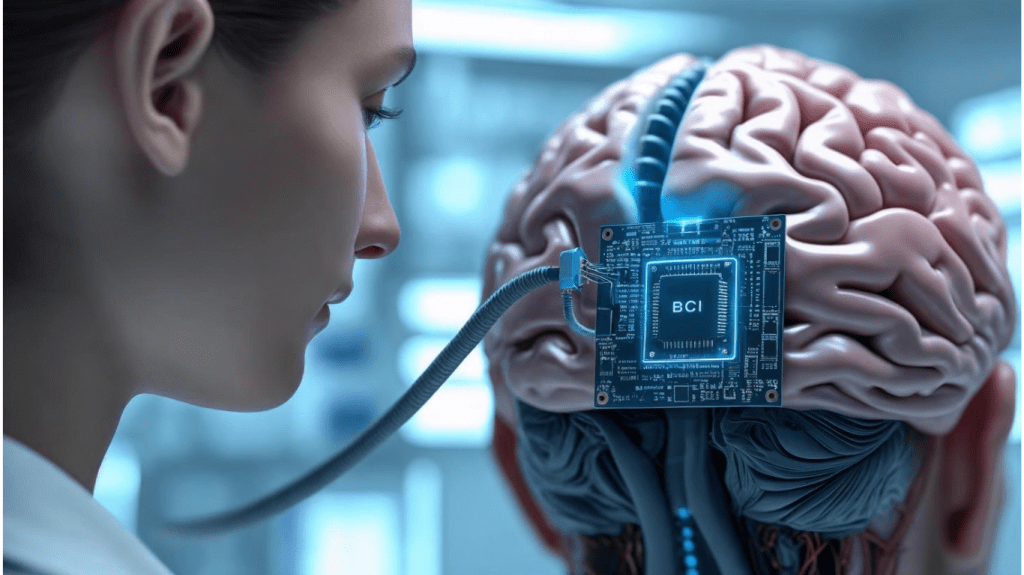
Beijing, July 22, 2025 — In a revolutionary moment at a central Beijing hospital, a 67-year-old woman with amyotrophic lateral sclerosis (ALS) uttered her first words in years,“I want to eat”using only her thoughts. Thanks to the Beinao‑1 brain-computer interface (BCI), Chinese characters appeared on a screen and were read aloud, marking a major milestone in speech restoration technology.
The Technology Behind the Breakthrough
Beinao‑1, developed by the Chinese Institute for Brain Research (CIBR) in collaboration with NeuCyber NeuroTech, is a semi-invasive wireless implant. Unlike deep-brain systems, it sits atop the cortex. This minimizes risk while capturing brain signals to convert into text or speech.
Trials began in March 2025 and have so far involved five patients with ALS, all having lost their ability to speak. The system recorded neural signals and translated them into vocalized phrases via a connected computer
The Beinao-1 Journey
In March, Luo Minmin, director of CIBR and NeuCyber’s chief scientist, announced that Beinao‑1 had already been implanted in three patients, with 10 more scheduled for 2025
Following regulatory approvals, a 50‑patient clinical trial is planned for 2026; the broader ambition targets 50–100 patients eventually. Over 60% of interested individuals have already reached out for experimental access, signaling high demand.
Global Context
In the United States, brain-computer interface efforts are led by companies like Neuralink, which received FDA breakthrough device approval in May 2025 and has begun early human trials with fully implanted deep-brain chips. Synchron, another key player, currently leads in trial numbers with implants in 10 patients across the U.S. and Australia. However, experts observe that China is rapidly transitioning from lab research to clinical application. As one neuroscience professor noted.
“China has definitely shown the ability to not just catch up but also then be competitive and now actually to start also to drive the field in some areas,” -Max Riesenhuber, a professor of neuroscience at Georgetown University, said per the network.
Brain chip
Patient & Researcher Perspectives
Patients report a powerful emotional impact. Luo Minmin described the experience as “incredible” and emphasize the regained control over speech and expression.
“The patients were saying that this feels so great, like they can regain the control of the muscles,” -Luo
Beinao‑1 enables communication through simple but critical needs and could act as a stepping stone toward expressing complex thoughts and emotions.
Why This Breakthrough Matters
The Beinao‑1 brain chip is transforming communication for ALS patients, enabling them to express basic needs like “I want to eat” using only their thoughts. Unlike U.S. devices still in early trials, Beinao‑1 is moving rapidly toward clinical use in China. This progress is intensifying the global brain-tech race, pushing the U.S. to accelerate its own brain-computer interface developments.
Bienao-2 On The Way
A next-generation version of the brain chip, Beinao‑2, is already in development and will be fully implanted, with human trials expected within the next 12 to 18 months. Meanwhile, clinical trials for Beinao‑1 are expanding, with dozens more patients set to receive implants as researchers aim to meet regulatory milestones and release data on safety and accuracy. Whether this sparks global collaboration or intensifies competition, one thing is certain: speech-restoring brain-computer interfaces are moving swiftly from research labs into real-world use.

Leave a comment