
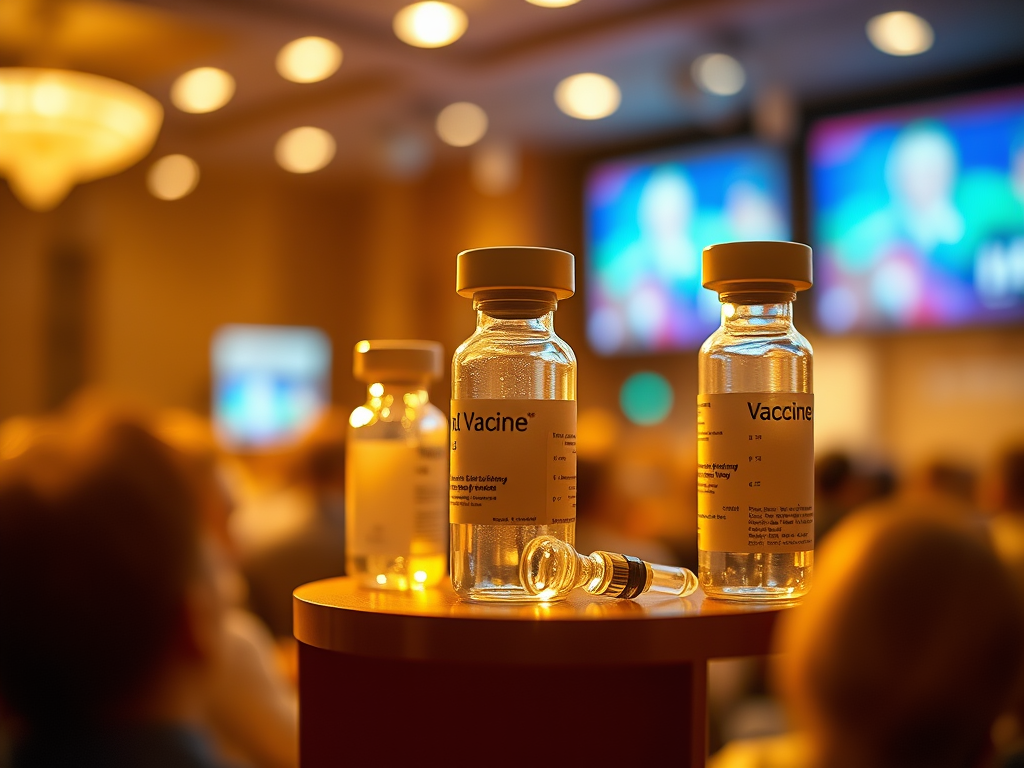
Private sector players turned out in force at this week’s Gavi Replenishment Summit, pledging more than US$6 billion in combined support for Gavi’s ambitious new five-year strategy, Gavi 6.0. The contributions, ranging from innovation accelerators to manufacturing partnerships, highlight the growing role of business and finance in shaping equitable global health outcomes. Their contributions enabled over US$9 billion mobilized yesterday, which is close to the target of US$11.9 billion
Record-Breaking Innovative Financing
In a show of financial ingenuity, development finance institutions announced over US$ 4.5 billion in new tools to boost Gavi’s impact. These include:
- US$ 3 billion in long-term partnerships with multilateral development banks (MDBs) to support countries transitioning from aid to self-financing.
- US$ 1.5 billion in liquidity facilities that allow Gavi rapid access to capital in the face of outbreaks or unexpected health emergencies.
Key announcements included:
- A landmark agreement with the Asian Infrastructure Investment Bank (AIIB) to unlock US$1 billion for public-sector health projects and US$500 million in new liquidity by 2026.
- A new agreement with the Asian Development Bank (ADB) to mobilize immunization financing across 36 countries in the Asia-Pacific region.
- An extension of the European Investment Bank’s EUR 1 billion financing facility to support both routine and emergency vaccine programmes.
- Strengthened collaboration with the World Bank to mobilize at least US$ 2 billion for immunization and health systems over five years, focusing on primary care and regional vaccine manufacturing in Africa.
African Manufacturing Front and Center
A key pillar of Gavi 6.0 is its African Vaccine Manufacturing Accelerator (AVMA), and the Brussels Summit brought tangible commitments:
- Biovac, a South African biopharmaceutical company and Biological E. Ltd, a major global vaccine supplier from India, signed a tech transfer agreement to produce and distribute a pneumococcal conjugate vaccine (PCV14), a priority vaccine under AVMA across Africa.
- MedAccess will partner with Gavi to design a up to $50 million in guarantee-based finance to African manufacturing projects.
- UNICEF set a goal for 20% of Africa’s vaccine demand to be met by WHO-prequalified African manufacturers by 2035.
Vaccine Manufacturers’ Major Price Reductions and Access Measures
Key commitments from vaccine manufacturers are expected to reduce costs and expand access significantly.
Bharat Biotech will reduce the price of the RTS,S/AS01 malaria vaccine to under US$ 5, with progressive implementation starting immediately.
GSK committed to cost savings of up to EUR 20 million through improved production efficiency, enabling Gavi to reach 50 million children with malaria vaccines from 2025 to 2030.
GSK also announced a 17% price reduction on its new rotavirus vaccine (blow-fill-seal presentation), translating to EUR 80 million in savings. The compact formulation will reduce countries’ cold chain storage needs by 30%, lowering operational costs.
MSD will continue supplying its HPV vaccines to Gavi-eligible countries at access pricing from 2026 to 2030. Additionally, MSD is working on a next-generation Ebola Zaire vaccine with Hilleman Laboratories, aiming for greater thermostability and supply if successful.
Serum Institute of India (SII) announced a significant price cut for its R21 malaria vaccine, potentially saving over US$ 100 million during Gavi 6.0. Continued access to its pneumococcal conjugate vaccine (PCV) at US$ 2 per dose for former Gavi-eligible countries and below US$ 4 for never Gavi-eligible middle-income countries. Certification of its multivalent meningococcal conjugate vaccine for controlled temperature chain (CTC) storage – up to 15 days outside the cold chain – easing logistical barriers in remote areas.
Private Sector Engagement for System-Wide Impact
The Gavi Replenishment Summit in Brussels saw the private sector step up with a suite of new partnerships and financial commitments worth over US$ 149 million, aimed at revolutionizing how vaccines are delivered and accessed in some of the world’s most underserved communities. Central to this is a landmark US$ 40 million anchor investment in Gavi’s newly launched Innovation Scale-Up Fund, designed to fast-track the implementation and scaling of impactful delivery innovations.
Key highlights include:
- Grand Challenges Canada committed up to US$40 million, subject to final structuring, to anchor the Innovation Scale-Up Fund, which will accelerate the scale-up of proven immunization delivery innovations across low-income settings.
- The “la Caixa” Foundation renewed its partnership with Gavi, pledging EUR 9 million (2025–2027). Leveraging the 1=4 matching fund model (including contributions from the Gates Foundation), this brings the total to EUR 36 million. The partnership is also expanding into Portugal through the new Alliance for Child Vaccination.
- A collective effort by the Children’s Investment Fund Foundation (CIFF), GiveWell, Arm, and a US-based foundation will see a proposed US$35 million co-investment. This portfolio will focus on integrated health and nutrition models, AI-powered digital tools, and strengthening in-country health systems, pending approval.
- Integrate Health and an international charity are mobilizing US$15 million in co-funding (2025–2030) to scale integrated primary health care in Guinea and another Gavi-supported country, boosting vaccine equity across West Africa, subject to final approvals.
- An international charity plans to contribute US$10 million through a Malaria Procurement Grant to help reduce child mortality in West Africa, pending final clearance.
- Gavi and Zipline are expanding their drone-based vaccine delivery system in Ghana, Côte d’Ivoire, Kenya, and Nigeria, backed by philanthropic donors and matched funds from the Gates Foundation, a partnership now valued at up to US$6 million. To date, over 23 million vaccine doses have been delivered through this initiative.
- In an innovative multi-party collaboration, Temasek Foundation, UBS Optimus Foundation, and the Clinton Health Access Initiative are launching a US$4.54 million project in Indonesia (Bekasi City and Bogor District). This effort, supported through the Gavi Matching Fund, will reach zero-dose and under-immunized children by strengthening primary care services through digital health and antenatal care.
- The Bayer Foundation has invested over US$2 million in catalytic funding to improve immunization access in agricultural communities across Africa, with plans to expand these efforts in partnership with Gavi and others.
- The UPS Foundation is contributing US$2 million to enhance supply chain networks critical to delivering vaccines to children in the world’s poorest nations.
- Signalytic, selected as an INFUSE Pacesetter 2024, will implement solar-powered digital health solutions in Rwandan health centers. This project is backed by US$1.8 million in support from Arm, The Coca-Cola Foundation, and Project Last Mile.
- Additional support includes US$100,000 from Workday to INFUSE and US$175,000 from a US-based family foundation.
- Iveco Group is finalizing a partnership with Gavi to support vaccine logistics in Gavi-eligible countries under Italy’s Mattei Plan, aligning with both Gavi’s 6.0 Strategy and Italy’s broader development agenda.
- Finally, with US$5.8 million from Arm and CIFF, as part of the previously mentioned contributions, Simprints is rolling out the world’s first open-source, AI-powered biometric ID system. This technology links infants to their health records without requiring hardware, and will support malaria and routine immunization delivery in Ghana.
Together, these private sector commitments gesture a commanding vote of confidence in Gavi’s ability to scale innovation, leverage market forces, and strengthen national health systems, especially in countries moving from donor aid toward self-sufficiency.
As Gavi aims to protect 500 million children through 2030, avert up to 9 million deaths, and unlock US$100 billion in economic benefits, its bet on public-private partnership appears stronger than ever.

Leave a comment