

The Kenyan politics have always fueled protests among the people of the land. While these protests have often been spearheaded by the opposition leader, Raila Odinga, the most recent national protest tagged GEN Z has stood out to be leaderless, tribeless, and party-less. These protests, while aimed at addressing grievances, often have broader implications on various sectors, including healthcare service delivery.

The GEN Z Protest
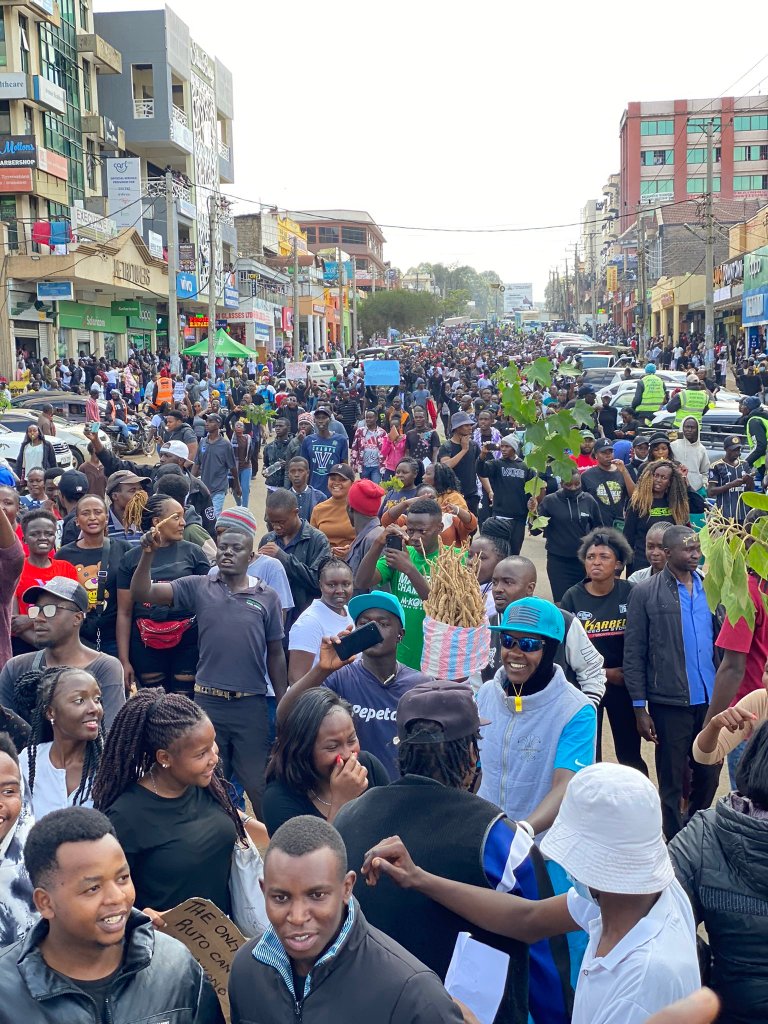
Young people organized a protest of a kind due to the proposed Finance Bill 2024. The nationwide protest held in almost all counties in Kenya was meant to #RejectFinanceBill2024. The protest that sparked global attention also had individuals in the diaspora in various countries gathering to #RejectFinanceBill2024. Being on the ground was not enough; X (formerly known as Twitter) had over 150,0000 users join an X space hosted by @Kimuzi. The X spaces were meant to psychologically prepare netizens for the on-ground demonstration. Of course, article 37 of the 2010 constitution of the Republic of Kenya allows for peaceful demonstrations. The well-organized GEN Z protest had Thousands of healthcare providers joining counties to offer pro bono services to injured people. Let’s delve into how the famous protest impacted healthcare delivery.
What are the Effects of Protests on Healthcare
Disruption of Services
The GEN Z protest involved roadblocks and mass gatherings, causing difficulty accessing healthcare facilities. On 25th July 2024, Thika Super Highway was blocked for hours. Vehicles coming from Githurai 45 could not access the town through it. This means that ambulances and patients might have faced difficulties reaching hospitals, leading to delays in treatment and emergencies.
Despite 1000 medics and over 10 ambulances on ground during protest to provide services in Nairobi only, the situation was overwhelming that they called for help from other humanitarian organizations. Dr. Austin Omondi posted on his X saying:
“Medics are currently overwhelmed by gunshot wound patients. Kindly @EMS_Kenya @KenyaRedCross help medics evacuate the wounded. @kmpdu @KenyaMedics_KMA“

Resource Diversion
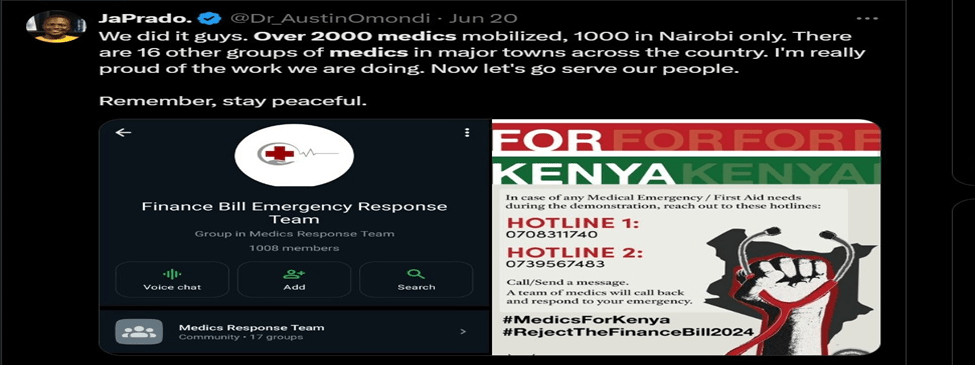
Doctors and emergency services were diverted to manage protests, leaving healthcare facilities with fewer resources to address medical needs. According to an X post by Dr. Austin, who mobilized medics to provide services on the ground for protesters, over 2000 active doctors were not at the health facilities during the GEN Z protest.
“We did it guys. Over 2000 medics in major towns across the country…”
Safety Concerns
During the GEN Z protests, doctors were teargassed, threatened, and injured. The organizer of the on-ground medical service @JaPrado on X was abducted and went missing for more than 24 hours. It took the effort of social media users on every platform to call for his release with the hashtag #FreeJaprado.

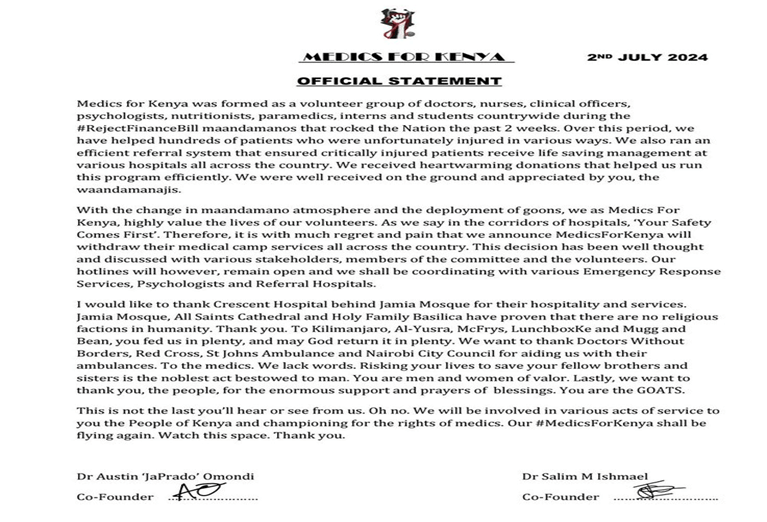
On 3rd July 2024, Medics For Kenya withdrew their services during the protest through a formal statement quoting compromised safety of the medics who went out to help the injured individuals during the protest.
Mental Health Impact
Protests create an atmosphere of unrest, causing stress for patients and healthcare workers. During the GEN Z protest, people witnessed their friends being injured right before their eyes. Families and friends have lost their loved ones who were shot dead. What can be said of a police officer who waved his family bye in the morning but could not do the same by evening after losing both hands during the protest. What of the police who witnessed his brother shot dead by his colleague? The mental state of most of the participants in the protests is compromised.
Public Trust and Engagement
Repeated protests will eventually erode public trust in the healthcare system. When people perceive that healthcare services are unreliable during demonstrations, they are less likely to seek medical help when needed, leading to poorer health outcomes.
Mitigation Strategies
Several strategies can be implemented to mitigate the impact of protests on healthcare service delivery. Strengthening emergency response is crucial as well as protecting healthcare workers, building strong relationships with communities to fosters mutual understanding and cooperation during protests, with community leaders being pivotal in ensuring healthcare services are respected and protected. Lastly, investing in resilient healthcare infrastructure is essential to withstand the impacts of protests and other forms of unrest.

Protests in Kenya, while a critical means of expressing societal grievances have notable implications for healthcare service delivery. The disruption of services, safety concerns for healthcare workers, and potential mental impact highlight the need for comprehensive strategies to mitigate these effects. By strengthening emergency response plans and protecting healthcare workers, Kenya can better navigate the challenges posed by protests to ensure continuous and effective healthcare service delivery, especially during the protests.

Leave a comment