
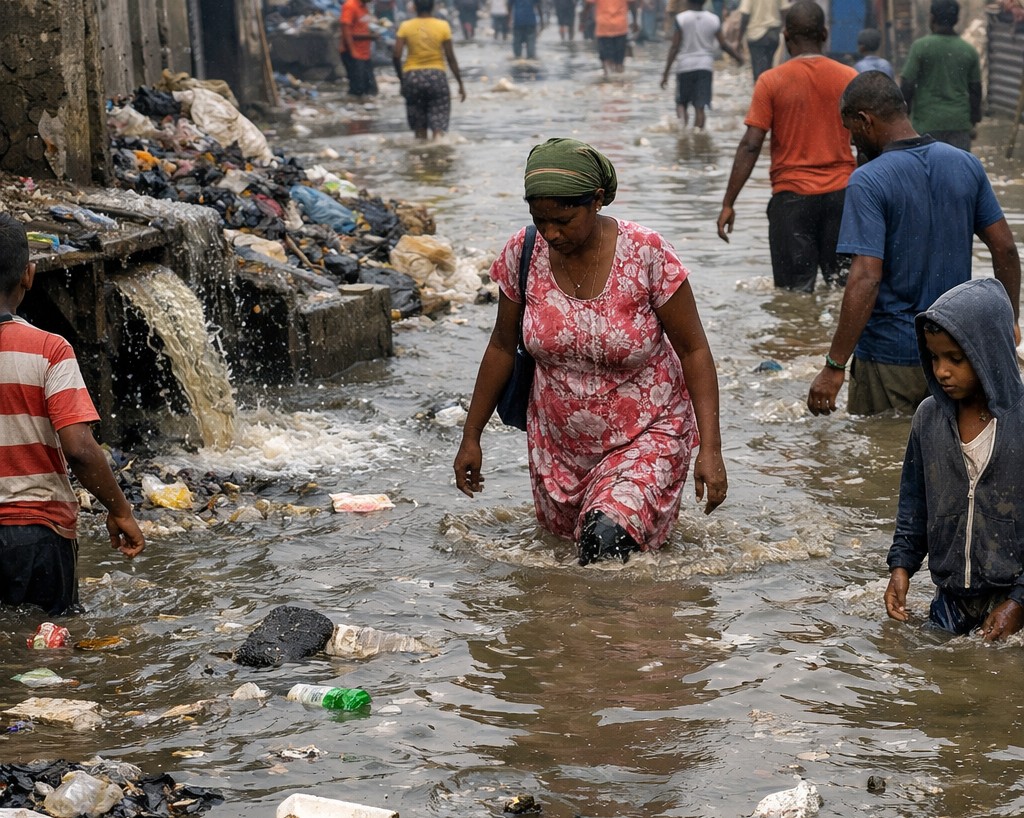
When the rains came to South Sudan in late 2024, they brought more than water. Between September 28, 2024, and March 18, 2025, more than 40,000 people fell sick with cholera (UNICEF, 2025). 694 died, half of them children under 15 years old. It became the country’s worst cholera outbreak in two decades.
But here’s what makes this different: the flood that triggered it didn’t start in South Sudan alone. And the cholera spreading through Luanda’s neighborhoods in Angola didn’t come from local water sources only. Across Africa, your neighbor’s climate disaster is becoming your health crisis.
Climate Change Is Rewriting Cholera’s Map Across Africa
Between January 2024 and March 2025, Eastern and Southern Africa recorded over 178,000 cholera cases and close to 2,900 deaths (UNICEF, 2025). The pattern reveals how climate extremes fuel cholera transmission.
The disease used to follow predictable rhythms–rainy seasons in rural areas, outbreaks you could prepare for. Not anymore. In 2024, the El Niño phenomenon brought droughts to Zambia and Zimbabwe while triggering floods and landslides in Kenya and Tanzania (WHO Regional Office for Africa, 2024). Both extremes created perfect conditions for cholera outbreaks.
Drought forces communities to dig deeper wells or share contaminated water sources. Cholera bacteria concentrate in the limited water that remains. When floods come, they overwhelm broken sanitation systems and wash human waste into drinking water. Either way, people get sick.
Africa’s Water Infrastructure Crisis Fuels Cholera Spread
The numbers on the ground are concerning. Almost 120 million people in Eastern and Southern Africa are drinking unsafe water, including 60 million children (UNICEF, 2025). Another 174 million have no access to hygiene facilities at home. At least 71 million people practice open defecation.
These aren’t abstractions. They’re families forced to choose between thirst and disease. They’re mothers walking kilometers to fetch water they know might kill their children.
Angola’s cholera outbreak shows what happens when water infrastructure crumbles under climate pressure. As of March 23, 2025, Angola reported 8,543 cases and 329 deaths across 16 provinces, with a case fatality rate of 3.9 percent–nearly four times the acceptable threshold (WHO, 2025). Children made up 40 percent of those infected.
The country has water. It has rain. What it lacks is infrastructure to deliver clean water or manage waste when extreme weather hits. Cyclones destroy water treatment facilities. Floods contaminate wells. Droughts drain reservoirs. Each disaster creates the conditions for the next cholera outbreak.
How Temperature Rise Doubles Cholera Risk in Africa
Climate change doesn’t cause cholera directly. But it multiplies every vulnerability until manageable challenges become catastrophes.
Between 2014 and 2024, cholera cases in Africa jumped 141 percent–from 105,287 to 254,075 cases (Africa CDC, 2025). Deaths increased 151 percent–from 1,882 to 4,725 deaths. This isn’t just about awareness or vaccines. It’s about what happens when rising temperatures meet crumbling infrastructure.
A single degree Celsius increase in temperature can double cholera cases. In Zanzibar, researchers found that a 1°C temperature rise resulted in a twofold increase in cholera cases (Bekele et al., 2025). Warmer water creates ideal breeding conditions for Vibrio cholerae bacteria. Irregular and unpredictable rainfall destroys the seasonal patterns that used to help communities prepare. Extreme weather overwhelms systems that were barely functioning.
The Democratic Republic of Congo, South Sudan, Sudan and Angola contributed to 72.5% of cases and 89.6% deaths of Africa’s cholera burden (Africa CDC, 2025). What these countries share isn’t just poverty. It’s the collision of climate extremes with weak health systems and inadequate water sanitation infrastructure.
Cross-Border Cholera Transmission: Your Community at Risk
If you think cholera is someone else’s problem, look closer. Cases once confined to rural areas during rainy seasons now appear in cities during dry months. Cholera outbreaks that used to burn out after a few weeks persist for years. Countries that hadn’t seen cholera in decades are reporting new cases.
The flood that hit a community two provinces away contaminated groundwater sources your community depends on. The drought forcing families to abandon their farms is pushing them into cities where informal settlements lack basic sanitation. The storm that destroyed water pipes hundreds of kilometers away is spreading bacteria to new areas.
This is the reality: in a climate-changed Africa, disease doesn’t respect borders or seasons. Your neighbor’s flood becomes your cholera crisis because we share the same broken infrastructure, the same stressed water systems, the same vulnerable children.
The Solutions Exist: Climate-Resilient Water Infrastructure Can Stop Cholera
The path forward requires action. Flood-proof water infrastructure. Better disease surveillance systems. Strategic oral cholera vaccination programs. Climate-resilient sanitation. But first, we need to see the connection between the flood waters rising somewhere else and the cholera outbreak that follows in our own communities. The next flood is coming, and cholera is coming with it.
References
Africa Centres for Disease Control and Prevention. (2025). Mid-year brief: Multi-country cholera outbreak in Africa (1 January – 31 July, 2025) https://africacdc.org/download/mid-year-brief-multi-country-cholera-outbreak-in-africa-1-january-31-july-2025/
Bekele, B. K., Uwishema, O., Bisetegn, L. D., Moubarak, A., Charline, M., Sibomana, P., & Onyeaka, C. V. P. (2025). Cholera in Africa: A Climate Change Crisis. Journal of epidemiology and global health, 15(1), 68.
UNICEF. (2025, March 24). Eastern and Southern Africa records over 178,000 cholera cases over 15 months, amid water, sanitation and hygiene challenges [Press release]. https://www.unicef.org/esa/press-releases/esa-records-over-178000-cholera-cases-over-15-months
World Health Organization. (2025, March 26). Cholera – Angola. Disease Outbreak News. https://www.who.int/emergencies/disease-outbreak-news/item/2025-DON562
World Health Organization Regional Office for Africa. Cholera in the WHO African Region. (2024, July 31). https://www.afro.who.int/health-topics/disease-outbreaks/cholera-who-african-region

Leave a comment